
It’s the end of May and beginning of June: one of my favorite times of year, when purple lilacs bloom, the new leaves rustle in warm winds, and it’s hot and bright enough to put on sunscreen and enjoy its cool, thick smell.
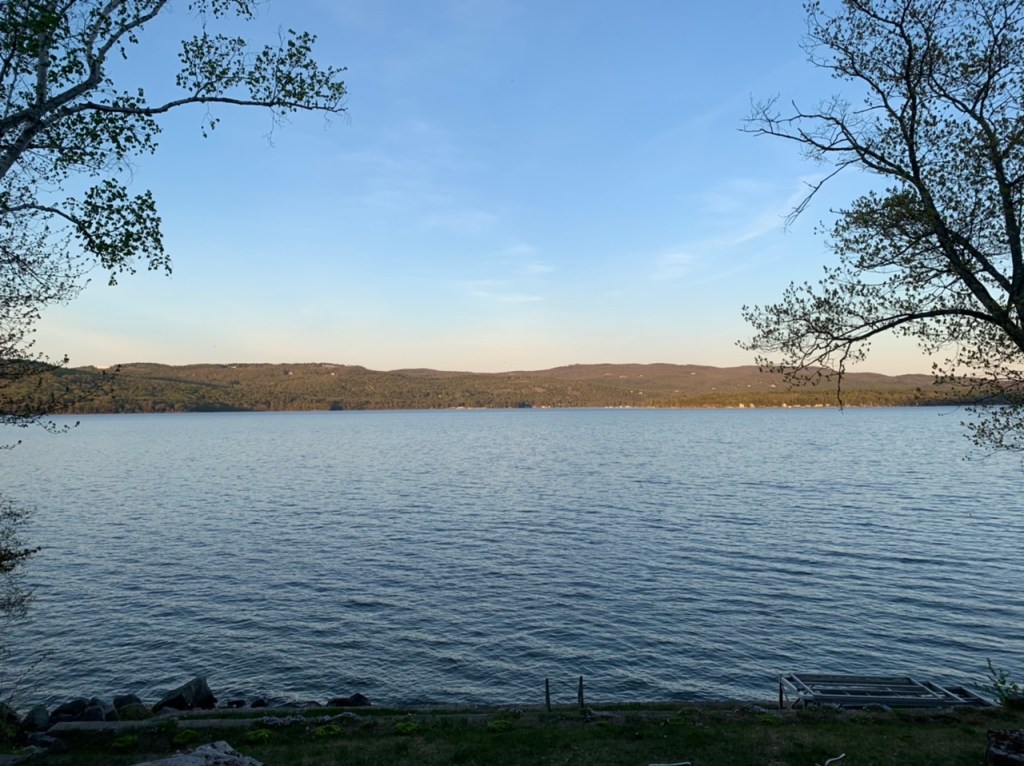
These days at the lake have “slid along so quiet and smooth and lovely” (Mark Twain, The Adventures of Huckleberry Finn). I’ve had the undeserved luxury of hiking in the green mountains, paddle boarding during my lunch hour, a few frigid swims, and continuing to research fairy tales and folklore for the Summer of Faerie project. I hope to post more about this later, but for now, I have found a few treasures:
- Kate Forrester’s Celtic Tales, a collection of British, Irish, Welsh, and Scottish legends with gorgeous silhouette illustrations
- J.R.R. Tolkien’s “Mythopoeia,” a poem I had heard of but not read (and do not fully understand yet)
- Angelina Stanford’s fascinating research on how fairy tales retell the Gospel
This week’s Summer of Faerie post is a piece by Matthew Cyr, whose masterful craftsmanship I first encountered in The Cultivating Project (a seasonal online journal). Matthew’s prose reminds me of an enchanted forest, with layers of vivid imagery and root-deep musings that leave me pondering for days. This short-short story explores some of the strangeness and mystery of the world of fairy tales.
Winds of Change
by Matthew Cyr
Eyes closed, head thrown back, Ehelia danced among the maple whirlywings, whirling with them as they fell. Cirigan watched her from where he was seated on a fallen linden trunk, playing a rippling tune on his polished swan’s bone flute. Merriment played on his usually-somber face as he followed Ehelia’s fluid spiraling.
As the breeze quickened and more of the winged seeds took flight, Ehelia swept up those around her and flung them back up to be joined by fresh ones from above. Again she swirled them up as they drifted down to her, and again until the air was awhir with spinning wings that flickered in and out of the dappled sunlight.
In the midst of her laughter something caught at Ehelia’s attention, as if a movement from the corner of her eye or a sound out of place, half-heard. She came to a stop and looked toward the river where it ran unseen behind the yarrow-clad hill.
Cirigan stopped piping. “What is it, Irushili?” He often called her that, Shower of Laughter, instead of her true name, which meant Heartsighted.
Ehelia had no word to give him back, but he followed when she started away toward the river.
Cresting the rise, she could see something heaped down by the water’s edge. She paused, then pushed closer. Cirigan crossed half in front of her and stopped, as did she. It was plainly a body, a figure lying as if spilled from a cup.
“Is that….” he began, without taking his eyes from the thing.
“Yes.” No cloud had passed over, but the sun-washed hilltop seemed to darken for a moment around them.
“I never thought… to find one outside of old tales. An Oulahlain. How came it here? None have ever been near this place. ” His eyes narrowed slightly. “It still lives.”
Ehelia passed him, only half aware that she was drifting closer to the creature again. Cirigan twitched slightly but didn’t move to block her. She looked and listened and smelled, taking in the crude clothing, the mane of tangled hair, the shallow breaths.
Ehelia’s gaze passed on to the angry red scratches on the arms and legs, as if it had been plunging through thorn and thicket. The figure’s feet had scarcely stopped bleeding into the river as it whispered past. The tears in the thing’s coarse-spun garment looked fresh as well, and some of its shabbiness the mark of recent hard use and weather.
“She was chased,” Ehelia said quietly.
“She?”
“She is female… and young, as they would reckon age. Little more than a child of her kind.” Ehelia didn’t try to unravel how she came by this surety, but Cirigan had known her long, and accepted it as truth without need of explanation.
“They’re dangerous at any size or age,” Cirigan said. “They all but destroyed our people. So few of us lived to flee here… and now again our place is found out.”
Ehelia made no reply, but the still air around her felt like a closed door. Cirigan turned to her, finally taking his eyes from the slumped creature to press Ehelia with his gaze.
“Where one comes, others will be drawn. If this one is hunted by its own kind, they that follow will be more and worse. They will bring the cold iron that slays our folk.”
Cirigan glanced back at the fallen thing on the riverbank. “Yet for it to return to its kind now might be more ruinous than if it remain. Could be that it will wander ever lost in the wilds instead…or a sleep be placed on it that it never wake.” He fingered the bone flute.
And now Ehelia turned to him. Her eyes, usually the pale green of the moon-moth’s wing, were like sunlight through young beech leaves. The floating tufts of cottonwood silk above the hillside seemed to slow in the air, and the river to further hush itself.
“None other will find its way here that we do not wish, “she said. “Our folk can keep the border.”
Like heat-shimmer off a sun-baked rock, she could feel the uncertainty rising from him, mingled with shame: none of their people would think to end a living thing before its time, but he had voiced the nearest deed to that.
“We must tell the others,” Cirigan said, his tone more subdued but still stubborn around the edges. “All must decide.”
Ehelia glided even closer to the strange figure till she hovered just over it. Under the burrs and dirt, the sleeper’s hair was ruddy-gold like a kingfisher’s breast, and fell across her eyes, hiding them.
The forest seemed to breathe again. Ehelia had made her decision. The breeze now wafted the cottonwood wisps into the river, which carried them past and on out of sight. A lift of air drew the sleeper’s hair away from her face, revealing a pale brow and lidded eyes. Oulahlain. The Unseeing Ones.
Soft, soft, like the feathered touch of a month’s antennae, Ehelia brushed the stranger’s eyelids with her fingertips. She whispered a few words that hung glistening in the air, like dewdrops on spider threads.
She knew without looking that Cirigan had vanished, as the figure shivered and its eyes sprang open. Eyes little less green than Ehelia’s own. The wakened creature drew back at the sight of her.
“Be at peace, Daughter of Man,” Ehelia said. “You are watched over, and none shall harm you here.”
Matthew Cyr

Once upon a time, Matthew Cyr unearthed an ancient-looking early edition of The Hobbit in his elementary school library and has been wandering in Middle Earth ever since. He has a hobbitish appetite and prefers to keep a good book in one hand and good food in the other. Matthew is fascinated by the power of story to awaken us to redemptive Truth. Several years ago he took up a quest to own and read every book ever published by C.S. Lewis. He shares his home with his wife and daughter, three cats, and a smallish serpent who has thus far never instigated the consumption of prohibited produce. Some of Matthew’s writings can be found at thecultivatingproject.com.

 Stories of Yearning