Scarlet, Sleigh, and Gift: How the Story of Santa Claus Reflects the Gospel

Christmas lights in the snow

I love this time of year: twinkling lights and glittering stars against the early dark; crimson and gold entwined in the rich green of wreaths and trees; the world-silencing wonder of the first snow; frost-flowers on window panes; the merriment that feels age-old and ever-new. This time of year, the story of the Myth-Become-Fact of Jesus Christ, the child of prophecy, reimposes its majesty, mystery, and closeness to our waking lives.

As I said in my last blog post, I really miss putting together “Leaf by Lantern” podcast episodes. I still don’t have the time to record, edit, and publish the audio, but I’ll keep writing out prose episodes as long as I have fairy tales and folktales to talk about.

For this episode/essay, I looked through a few fairy tales that could fit into a Christmas theme until I realized that there is a fascinating folk tale right at my fingertips to explore: Santa Claus. It is deeply sad that many have tried to replace the wondrous Incarnation, in all its holiness and mercy, with the story of a jolly, plump man who delivers presents — like replacing the sun with a cheap flashlight. But as I think about the tradition of Santa Claus, specifically the American version of the story I grew up hearing, I realize that it’s one of the better-known folktales of our age. Though it does have aspects of legend (history + fiction) going back to St. Nicholas of Myrna, who was a historical figure, elements like the North Pole, the reindeer, and the toyshop with elf employees have been added in and retold dozens of times. The “folk,” the common people, have made it our own. And like all good folktales, it points to the gospel.

Literary and film retellings of the folktale range from mythic and enchanting, like The Legend of Holly Claus and The Polar Express, to goofy, like Elf, Klaus, and The Santa Clause, to sweet, like the Prancer movies and Rudolph the Red-Nosed Reindeer, to tongue-in-cheek, like Red One of this year. Storytellers draw out the threads they like and reweave and reinterpret them: giving Santa various elaborate backstories, explaining the origins of the reindeer and North Pole workshop with greater detail, and incorporating other characters that the audience can relate to. I wrote a Santa retelling myself a few years ago, one of my favorite of my own stories, “Flight of the Gift-Giver.”

So I’ll look at the legend/folktale of Santa Claus in the same way I’ve looked at various fairy tales and ask:

  • How do the images in this story reflect the gospel?
  • How would a Christian artist who crafts a retelling of the Santa folktale do so in the light of Scripture, using the Bible as the reference for truth and beauty?

I’ll look at the images of Santa himself, the sleigh, and the naught vs. nice list.

Santa: Man and Myth

Most of the Santa figures I’ve seen in retellings portray him as jolly and silly, a good-hearted buffoon. He’s grandfatherly and more regal in Miracle on Thirty-Fourth Street and something more of a warrior in Rise of the Guardians. Michael Ward’s book Planet Narnia, which traces medieval planetary symbolism in C.S. Lewis’s Chronicles of Narnia, helped me to understand the Father Christmas who appears to the four children as a jovial figure, embodying the kingliness, magnanimity, wisdom, benevolent sovereignty, and peaceful prosperity of the medieval idea of Jove.

I see several Biblical images to work with in any retelling’s version of Santa:

  • The color red as luxury — The tabernacle and temple were full of “fine twined linen and blue and purple and scarlet yarns” (see Exodus 26:1 and many other verses in Exodus) and the wife of noble character of Proverbs 31 is “not afraid of snow for her household, for all her household are clothed in scarlet.” Scarlet or purple is a royal color, luxurious and lovely. Whether your Santa is stately and majestic, a kindly grandfather, a holy fool, or a more complex character with secrets and struggles of his own, I would not be afraid to lean into that regal aspect. He’s kingly, with authority over some sphere.
  • The color red as a representation of sin — “Come now, let us reason together, says the LORD: though your sins are like scarlet, they shall be as white as snow; though they are red like crimson, they shall become like wool.” (Isaiah 1:18, ESV). Red is the color of blood; the blood of bulls and goats atoning for Israel’s sin over and over, never enough, and the blood of the Lord Jesus shed once and for all as the Lamb of God. The paradox of a color that represents sin and the deliverance from sin is fascinating. How might your Santa represent the paradox of sin and redemption? How could he reflect the Messiah who was made to “be sin who knew no sin, so that in him we might become the righteousness of God” (2 Corinthians 5:21)?
  • Santa’s entry through the chimney — I don’t want to overanalyze this image (it may partly be functional — just a way of explaining to children why Santa doesn’t need a housekey) but I find it intriguing that Santa enters from above through an avenue normally reserved for fire. It reminds me of the Lord sending down fire in judgement on Sodom and Gomorrah in Genesis 19; in proof of His sovereignty in 1 Kings 18; in an outpouring of the Spirit with wind and tongues of fire at Pentecost in Acts 2. The fact that Santa comes with gifts instead of judgment reminds me of Christ who came to offer sinners a hope undeserved. How might the chimney/fire from above/hearthfire factor into your Santa’s abilities and character?
  • Santa as undying — Santa is an old man but immortal. He represents an age-old hope that never dies. While his joviality is, well, Jovial (again, the medieval idea of Jove is of a kingly, generous, serene figure), I also see a possible link to Saturn or Father Time. He serves as a foil for Christ, who came as a child and will never age or die. How would ageless age affect the character of your Santa?

Whether you’re drawn to the goofy or the phantasmagorical in developing your Santa, I would argue one last thing: the imagery of the Santa tale is good. I don’t see a good case for making him a villain. I might also suggest exploring Santa’s role as a guide between the ordinary and magical, like Mary Poppins or Peter Pan: someone who knows the deep secrets of the world and helps others on their quests, their journeys towards happy endings.

The Sleigh and Divine Intervention

The image of Santa’s sleigh pulled by flying reindeer past a gigantic moon is iconic. The sleigh’s passage from sky to individual homes links it with many passages about heaven meeting earth, the divine intervening in human history, the Most High reaching down to our humble estate to rescue us. The image of the flying sleigh coming at night reflects the image of Christ coming to us as light in our darkness, life to our shadow-lives of spiritual death.

But Santa’s flying sleigh intersects beautifully with another of my favorite Biblical images: the “chariots of fire and horses of fire” that come for Elijah the prophet when he “went up by a whirlwind into heaven”at the end of his life (2 Kings 2:9-12). Since reading this story in nightly Bible story time when I was little, I have a fierce, aching jealousy of Elijah’s flight from earth.

Thus the Bible has two glorious images you could use to beautify a Santa Claus retelling:

  • Divine intervention — Light in darkness; a redeemer who “descended”; a healer who comes to a land of terrible sickness; the Gospel of John, Paul’s letters, and many other passages of Scripture give soul-stirring metaphors to teach us what Christ did by coming to us. The more you can emphasize the sleigh as representing heaven’s reaching down to earth — joy in the midst of despair, the healing of a sickness, the lifting of a curse, the fall of an evil dominion, delight that overcomes despair — the closer you can bring your retelling to the mystery of the gospel.
  • Wind and fire — If you really want to dress up Santa’s sleigh, the fiery chariot and whirlwind of 2 Kings 2 could set your story ablaze. The image of fire in the cold of winter (apologies to anyone in the southern hemisphere who celebrates a warm Christmas) is also a beautiful one. The image of Elijah’s fiery chariot also connects with Santa’s entrance through the chimney . . . it’s intriguing how much fire lies hidden in this story’s images.

The Naughty vs. Nice Lists: The Law and Grace

At first glance, the naughty vs. nice list of the Santa folktale is nothing but the old, cheap trick of scaring children into good behavior. At second glance, it’s even worse: pharisaical works-righteousness and legalism, the lie that you can save yourself by Following the Rules. Spiritually, we are all much worse than naughty and deserve much worse than lumps of coal; that’s why we need grace.

And yet . . . as I look at it, the naughty vs. nice list and threat of coal vs. gifts could actually match up to the gospel in a different way. I’m reminded of Paul’s words about the Old Testament law: the law was like a guardian for the people of Israel (see Galatians 3). It was good in that it taught them the difference between sin and righteousness, holiness and defilement. The problem was that they could not keep the law on their own. They failed again and again by worshipping idols, intermarrying with other nations, or even with disobedient hearts as they keep the outward tenets of the law (see the entire Old Testament, or for a good picture of the situation, Isaiah 1). So the naughty vs. nice list may actually have that truth in it, the difference between right and wrong. And apart from Christ, we are all in the wrong.

The threat of getting a lump of coal instead of a gift has some interesting implications as well. In Isaiah 6, the prophet Isaiah is dismayed to find that he, a sinful man, has seen the Lord in his temple, attended by seraphs. In response, one of the seraphs brings him a flaming coal and touches it to his lips. “And he touched my mouth and said: ‘Behold, this has touched your lips; your guilt is taken away, and your sin atoned for’” (Isaiah 6:7, ESV). In a Santa retelling, an artist could take the disappointing gift of coal and turn it into something ironically wonderful and mysterious: something that purifies, restores, and redeems.

What about good gifts that are alternatives to coal? I don’t feel that plastic toys and mindless entertainment make the best symbol for the awesome gift of eternal oneness with the Living God. But as I thought about it, the idea of a child’s toy as something meant simply for joy and wonder, not a tool for labor or education, reflects the gratuitous, abundant richness of God’s goodness. If coal could be something glorious, what would a more direct symbol of divine grace be? I had a couple of ideas:

  • A gold ring — Gold as a nod to the golden streets of heaven; a ring as a sign of the covenant between Christ and His Bride, the Church
  • A key — Something that would open doors to adventure and mystery in your story, and also reflect Christ’s possession of the key of David (Revelation 3:7)
  • A dove — A living creature who acts as a guide, counselor, comforter, or helper, as a nod to the Holy Spirit
  • A music box or musical instrument — Something of delicate workmanship that makes music, an outlet of praise and awe

Hope everyone has a Merry Christmas! May good stories, feasting, and fellowship renew our wonder in the love of the Mighty King who clothes us in righteousness, washes us white as snow, descended into our darkness, and gives us the gift of Himself.

“The Seal-Catcher and the Merman”: The Sea, A Healing, and Gold


A few weeks ago, I looked up at the slender crescent of gold moon, exquisitely curved, and realized I could see the dark orb of the moon it outlined. These days of November have been a rush of warm, radiant days; leaves drifting slowly down to a crunchy, fragrant carpet; raindrops glittering on red crabapples; heart-shaped Japanese maple leaves on stone steps; thousands of acorns littering the grass; plump squirrels racing up and down trees, shaking the branches; dark evenings where the stars come out long before bedtime.

I love this time of year. The rush of busyness has felt somewhere between an overwhelming tsunami and a welcome high tide after the stillness of summer. Some of my favorite holidays are ahead; I get to wear cozy socks and sweaters, put up twinkle lights, sip ginger tea, and shiver happily in the chilliness that is not yet brutal cold.

In this cozy, glittering season, I miss preparing Leaf by Lantern podcast episodes. Researching, drafting, editing scripts, recording, editing audio, and producing for this podcast turned out to be too many hours of work for me with a full-time job and other commitments, but I loved studying fairy tales in the light of Scripture and dreaming about how Christian artists could approach retelling them.

I decided to indulge that literary/scholarly/artistic part of myself again and discuss one of the tales I had on my podcast episode to-do list, “The Seal-Catcher and the Merman,” in written form in this post.

“The Seal-Catcher and the Merman” is a Scottish folktale, very Scottish depending on what words you use in the telling. It’s a close kin of the “Selkie Wife” tale I talked about on the podcast.

“The Seal-Catcher and the Merman”: A Podcast in Written Form

The purpose of the Leaf by Lantern podcast was to explore “retelling fairy tales in the light of Scripture”: discussing how a Biblical perspective could guide an artist who is adapting a fairy tale into a novel, play, musical, short story, poem, or other written art form. See episode 1 for the full explanation of the project.

I began each episode by reading aloud my own “iteration” of the fairy tale to a) familiarize everyone with the story, and b) avoid the copyright issues of reading aloud someone else’s version. Here’s my iteration of “The Seal-Catcher and the Merman” from here, here, and here. Then, I usually discuss 2-4 images in each tale, how they relate to Scriptural images, and how Scripture could inform a retelling that includes that image. For this folktale, I’ll talk about the images of the sea, the healing, and the gold.

Once upon a time, on the cold north coast of Scotland, there lived a fisherman who was especially famous for catching seals. Some in the village whispered that the larger seals he caught, called “Roane,” were not seals at all, but merfolk who felt and spoke as humans do, but he laughed at their tales.

“The bigger ones catch me a better profit!” he said.

One morning, the Seal-Catcher snuck up on a large seal sunning itself on a rock and stabbed it in the side with his knife. The seal fell into the sea with a cry of pain, taking the knife with it. The Seal-Catcher went home in bitter frustration, as he had lost his catch and his favorite knife as well.

At twilight, he answered a knock at his door. A handsome stranger with a black horse stood there. There was something strange about the stranger’s face and appearance the Seal-Catcher could not name, but he thought it must be his fine coat and air of wealth and authority.

“I need a number of seal skins right away,” said the stranger. “I’m told you are the best seal-catcher in the north.”

“That may be,” said the Seal-Catcher, “but I can only get you a few seal skins so soon.”

“I know a place where a number of seals gather,” said the stranger. “Come with me, and I’ll make you rich.”

Eager for such a catch, the Seal-Catcher mounted on the black horse behind the stranger and rode off with him. They rode far up the coast to a lonely spot along a rugged cliff.

“We’ve reached the place,” said the stranger, dismounting and telling the Seal-Catcher to do the same.

“I don’t see seals here,” said the Seal-Catcher, surprised and beginning to be afraid to be with a mysterious stranger in this lonely place.

“Then come and see!” said the stranger, and he seized the Seal-Catcher and dragged him off the cliff into the blue sea.

The Seal-Catcher was terrified, but he could not resist the stranger as they hurtled into the waves and down, down, down, far below the sunlight. He gave up all hope until he found that deep as they were, he could breathe.

They descended into a rocky cavern full of shells in shimmering rainbow colors. Dozens of seal swam about there, and to the Seal-Catcher’s astonishment, they seemed to be crying and lamenting. He received another shock when he realized that he had brown fur and flippers just like they did. He had taken the form of a seal.

The stranger, who had also taken a seal shape, turned to him. “My father, the king of the merfolk, was wounded this morning by a knife,” he said. “Do you recognize it?” and he produced in his flipper the Seal-Catcher’s own knife.

The Seal-Catcher fell to the ground, begging for his life, believing that he had been brought there to be killed. The seals in the cavern crowded around him, gently rubbing him with their noses and assuring him that no one would harm him.

“I didn’t bring you here for revenge,” said the stranger. “I brought you for healing. Come.”

He led the Seal-Catcher into a glimmering chamber in which the seal he had wounded lay, desperately sick, with a great wound in his side. “Lay your flippers on his wound, and he will heal,” said the Seal-Prince.

“I have no power to heal,” said the Seal-Catcher in fear and surprise, but he obeyed, laying his seal flippers on the king’s wound. Immediately, the wound closed up and the bleeding stopped.

The seals turned from lamenting to rejoicing, crowding around the king and the Seal-Catcher. “I will take you back to your wife and children now,” said the Seal-Prince, “on one condition: that you will never harm a seal again.”

The Seal-Catcher made this promise. The Seal-Prince carried him back to the surface, where they regained human shape, and rode him back to his house on the black horse.

When they arrived, the Seal-Prince let the Seal-Catcher down and took something out of his pocket. “Never let it be said that we took a man’s livelihood and gave him nothing in return,” he said, putting a bag into the Seal-Catcher’s hands. Then he rode away.

The Seal-Catcher opened the bag and found it full of shining gold. The seals had made him rich for the rest of his days.

The End

The Sea of Chaos

As I talked about in the podcast episodes on “Aspittle and the Stoorworm” and “The Selkie Wife,” the Biblical image of the sea is the realm of chaos. In the Lexham Bible Dictionary, D. Sarlo puts it this way:

In some Old Testament passages, the term “sea” (יָם, yam) is used to refer to the chaotic abyss that was the original state of the world prior to creation. This primordial sea was believed to have covered the whole earth (Gen 1:1–2:4a; Pss 18; 29; 89; Job 9:8; 26:12–13). . . . Walton notes that ancients imagined the primordial sea as encircling the earth like a serpent (Walton 2006: 166–167).

Sarlo, D. (2016). “Sea.” In J. D. Barry, D. Bomar, D. R. Brown, R. Klippenstein, D. Mangum, C. Sinclair
Wolcott, L. Wentz, E. Ritzema, & W. Widder (Eds.), The Lexham Bible Dictionary. Lexham Press.
Walton, John H. Ancient Near Eastern Thought and the Old Testament: Introducing the
Conceptual World of the Hebrew Bible. Grand Rapids, Mich.: Baker Academic, 2006.

For more on the Biblical imagery of the sea, I recommend the Bible Project’ recent episode, “A Mountain Rising from Chaos Waters.” Andy Patton also has some beautiful articles on water/sea/river imagery in Scripture on his Substack, “Pattern Bible.”

Interestingly, the sea in this Celtic folktale is not exactly the same as the Biblical sea of chaos, but it’s not a complete counter-image, either. Like “The Selkie Wife,” “The Seal-Catcher and the Merman” portrays the sea as the home of seals, merpeople, or selkies: gentle folk who, in those particular stories, are the targets of human violence and greed. But Scottish fisherfolk who got their living from the cold Atlantic and knew the brutality of winter storms wouldn’t view the sea as the realm of happy and innocent fun, either.

But in one particular aspect, the folktale rings true with a Biblical image: the sea as a place of reckoning. Lost in the waters of chaos, the rebel realizes the weight of his sin and cries out for rescue.

The parallels between “The Seal-Catcher and the Merman” and the book of Jonah are unmistakable. Like Jonah, the Seal-Catcher is going determinedly his own way, when he is dragged into the sea by force (Jonah 1-2). It is after they’re dragged under the waves that each character realizes his wrongdoing and repents. In that repentance, they receive a new life. Jonah’s prayer in Jonah 2 is a stirring depiction of death and rebirth:

From Jonah 2:2 (ESV)
. . . I called out to the Lord, out of my distress,
and he answered me;
out of the belly of Sheol I cried,
and you heard my voice.

Death (in Sheol, the grave) and rebirth; purification and repentance. There’s also an echo of baptism (see 1 Peter 3:18-20) — with the important distinction that baptism is a willing declaration of belief, and being dragged into the sea is involuntary (fairy tales and folk tales are never exact allegories of Scripture).

For anyone retelling “The Seal-Catcher and the Merman,” I have a couple of suggestions when it comes to handling the image of the sea:

  • Take your audience there — Just as Jonah’s prayer captures the sea in vivid poetic images, give your readers as concrete and vivid an image of the ocean as you can. (“All your waves and billows passed over me”; “The roots of the mountains” — in his prayer, Jonah brings us down with him). This suggestion is something of an obvious one since concrete, detail-rich prose is an ingredient of all good writing, but I think it’s crucial here, where the physical experience of near-drowning is so closely tied to spiritual death.
  • Explore oceanic myths, legends, and tales — As rich as this folktale’s images here, if a writer wanted to expand it into a novel or a full musical, they would need to expand the plot. The world is full of fascinating and beautiful oceanic myths and legends: Poseidon and his trident, merfolk, krakens, the Land Under Waves, Tír na nÓg, Atlantis, the Fata Morgana, the lost paradise in the Arctic. I would try to keep hold of the rich images of this folktale, but broadening the character list and worldbuilding of a longer story could add new richness. The paradoxes of oceanic chaos and wonder, wealth and destruction, secrets and adventure resonate across all traditions.

The Laying on of Hands

The Seal-Catcher’s ability to heal the Seal-King’s wound is an inbreak of grace in the story; he is no healer, and putting your hand on a wound does not ordinarily heal it. In fact, there’s an old superstition that if a murderer touches the dead body of one of his victims, the body will bleed. The Seal-Catcher’s touch here does the opposite, healing what he harmed. What fascinates me is that it’s an act of grace, but not grace for the Seal-King; grace for the Seal-Catcher, who is given, undeservedly and unexpectedly, the power to restore what he marred.

In Scripture, the “laying on of hands” is a sacred act. In Matthew 19:13-15, the disciples rebuke people who bring children to the Lord Jesus “that he might lay his hands on them and pray.” The Lord Jesus then says one of His most remembered and beloved sayings: ““Let the little children come to me and do not hinder them, for to such belongs the kingdom of heaven” (ESV). Then He lays His hands on them and goes away. The Lord Jesus heals others by layings His hands on them, including a woman who was bent over with a disabling spirit for 18 years (Luke 13:10-13).

In Mark 16, the Lord Jesus gives the power of healing by the laying on of hands to believers: “And these signs will accompany those who believe: in my name they will cast out demons; they will speak in new tongues; they will pick up serpents with their hands; and if they drink any deadly poison, it will not hurt them; they will lay their hands on the sick, and they will recover.” (“Mark 16:17-18, ESV, my emphasis). This promise blossoms into glorious fruition in the book of Acts, when the apostles lay their hands on people and pray for them so they receive the Holy Spirit (Acts 8:14-19, Acts 19:6) or receive healing (Acts 9, including the day when Ananias laid his hands on blinded Saul the persecutor and prayed so that God restored Saul’s sight).

Physical healing, and receiving the Holy Spirit — two blessings that link heaven and earth, the material and the spiritual, the temporal and the eternal. In “The Seal-Catcher and the Merman,” the image of a Seal-Catcher laying his hands (well, flippers, since he’s in seal form) on the wounded side of a king and watched the wound seal itself and disappear beautifully illustrates divine grace, redemption, restoration, and the gift of Christ-followers becoming like Christ. The Seal-Catcher’s very identity changes here: he goes from killer to healer, ravager to repentant and forgiven sinner. It reminds me of C.S. Lewis’s The Lion, the Witch, and the Wardrobe, how Aslan, the King of the Wood, extends his royalty to the children by crowning them as kings and queens under him.

For any Christ-follower who creates a retelling of “The Seal-Catcher and the Merman,” I would recommend a couple of things when it comes to this part of the story:

  • Make the identity change clear — A storyteller has a whole treasure chest of resources when it comes to depicting an identity change. Names; clothing; occupation; house and home; relationships; habits; speech patterns; a significant change to any of these can signify an identity change. Because of the change in his spiritual identity, the Seal-Catcher at the beginning of any retelling should act, feel, and even look dramatically different than the main character at the end.
  • Honor the concrete details — Touch is powerful. A Biblical laying-on-of-hands articulates something beyond words. In any retelling, I would do my best to hallow this moment with a vivid description: long or short, metaphorical or literal, memory-laden or present-focused, this would be a moment where eternal realities make themselves known in our time.

The Grace of Gold

I love the ending of this folktale. The Seal-Catcher has gone through a total heart-change and identity-shift from careless laughter to repentance, killing to healing, and death to life. The Seal-Prince’s gift of gold encapsulates the inheritance that believers have through the Lord Jesus. We are not only delivered from sin and death, but gifted oneness with the Father, Son, and Holy Spirit (John 17) and eternal communion with God in the glorious New Jerusalem (Revelation 21). In the goodness of God, our cup overflows (Psalm 23:5).

It’s a delicate thing to try to portray the joy of forgiveness without risking melodrama or overemotionalism. Staying in the realm of sensory details, in a retelling of this folktale, I would think through how the physical world would look and feel to a man who has been forgiven and made rich, like this: the colors of the sky, the familiar things of home, and thoughts of the future. My writing teacher, Jonathan Rogers, has talked about how good prose helps you see out of a character’s eyes and not your own (see his online course on writing lessons from The Hobbit), so that you teach readers what this person is like by displaying what they notice, how they see. What would a redeemed Seal-Catcher feel and notice? How would a new man treat the world he knew?

How do we believers see and walk in this world of stars and seas, knowing how fully we’re forgiven, and how deeply we’re loved?

Lazy Late Summer

Summer days were just a magazine, a magazine, a magazine . . . 
Cutting grass for gasoline
For gasoline, so I can see ya soon . . .
“Dandelion Wine” by Gregory Alan Isakov

Gregory Alan Isakov is one of the best living poets I know of. His metaphors are rich, sweet delights that summon moods and moments, dreams and memories like spells. In “Dandelion Wine,” he captures the lazy, wistful, sultry days of late summer in that lovely image of dandelion wine – the golden flower-weeds that dot the green grass, the sleepy pleasure of drinking in the sun and the quiet of long days. 

It’s getting towards late summer now. Air that was heavy with humidity is now soft with cool breezes; the oaks bear little clusters of acorns turning from green to brown; dainty Queen Anne’s lace and radiant goldenrod are flowering in the ditches; the whir of cicadas and cooing of mourning doves sounds dreamy and content. After a tumultuous year, I’ve found that returning to things I love like Isakov’s music, T.S. Eliot’s Four Quartets, Lewis’s Chronicles of Narnia, and the Nancy Drew books is deeply comforting. It has been harder lately to feel that “yearning” that I made the theme of this blog — that deep, sweet longing for the presence of God — but good old stories, songs, and poems stir up the memory of it. Best of all are Psalms like Psalm 34 in its tenderness and Psalm 36 in its joyful wonder; I find the thirsty roots of my soul stretching into those passages.

Psalm 36:7-9 — 
7  How precious is your steadfast love, O God!
The children of mankind take refuge in the shadow of your wings.
8  They feast on the abundance of your house,
and you give them drink from the river of your delights.
9  For with you is the fountain of life;
in your light do we see light.

After spending last summer pouring over fairy tales for the Leaf by Lantern podcast, I decided to mix things up this summer and try to write a historical fiction/mystery set in New England in the 1950s. It’s definitely challenged my research skills. I want to summon the music of the past in minute detail: the use of suntan lotion vs. sunscreen, for example, the swish of circle skirts, the necessity of starching and ironing everything, the shadow of the Korean War, and the use of telegrams/radio/letters for communicating and spreading news. Great historical fiction authors like Eloise Jarvis McGraw and Rosemary Sutcliff managed to capture the smells, tastes, sounds, and textures of long ago in gorgeous detail, and I want to imitate them, but it takes a lot of digging to get there.

Wanderings in Faerie

But I still want some fantasy in my life. I finished Junius Johnson’s “Summer of Fairies” course with a rereading of George MacDonald’s Phantastes – a weird, wonderful song of Romanticism and fairy tale beautified with a Scriptural vision of redemption. We’ve explored the nature and characteristics of Faerie, Fairy Land, Elfland, or whatever others call the fairy world and what makes it fascinating and dangerous. 

One thing that’s surprised me in this course is realizing that the land of Faerie is perilous for the reader as well as the character. In a world where normal rules don’t apply and new, terrifying ones spring up, like “don’t tell anyone your true name” or “don’t eat any of the food or you’ll get stuck here,” you want a loving, wise guide like Tolkien, MacDonald, or Lewis with you. Tolkien, MacDonald, Lewis, and storytellers like them witness to the Lord who is Good Shepherd. He sees every lonely wanderer, every lost soul who gets caught in a trap of their own making, and offers a safe haven of forgiveness. I read the ebook version of Tolkien’s short story “Smith of Wooten Major” with Pauline Baynes’s bewitching illustrations, and that sense of sovereign mercy even in a perilous realm is so beautiful:

But he [the main character, Smith] had business of its own kind in Faery, and he was welcome there; for the star shone bright on his brow, and he was as safe as a mortal can be in that perilous country. The Lesser Evils avoided the star, and from the Greater Evils he was guarded.

“Smith of Wooten Major” by J.R.R. Tolkien

Authors who don’t have that Scriptural view of reality and shepherdly love for their readers can lead you down some dark roads. Faerie is, by nature, inexplicable and unmappable, but heaven’s love and justice are just as sovereign there as everywhere else.  

Saturnine Stories in the Light of Scripture

I’ve thought more about stories that lead their audiences down dark roads from a recent conversation with my dad. He asked me if the newish Marvel show, “Secret Invasion,” featuring an older Nick Fury battling a new threat, was any good. I had tried it out a few months before and didn’t like it. 

“It’s kind of sad,” I explained. “Nick Fury is older and keeps making mistakes, and everyone keeps reminding him that he’s not as strong and smart as when he was young, and some really lovable characters die, and it just feels like all the good times are gone and there’s nothing left. I don’t like those kinds of stories.” 

My dad thought for a moment. “Was it saturnine?” he asked. 

I gaped at him. We’d both read Michael Ward’s Planet Narnia years before; my dad was referencing Ward’s argument that the seven books of Lewis’s series are written in the spirit of the seven medieval planets. Each Narnia book has the tone, atmosphere, and resonance of each planet. It’s too long a thesis to describe here, but Ward argues that The Last Battle is written in the spirit of the planet Saturn: a spirit of decay, loss, old age, and death, good times past. Google “saturnine” and you’ll find various definitions of a person or mood that is cold, gloomy, forbidding, bitter, and sardonic. Ward explains how Lewis’s Christian vision reveals good, redemptive aspects of Saturn (read the book to find out more about that) but a saturnine story without that Scriptural hope is unreasonably depressing. My dad was dead center: “Secret Invasion,” or at least, the first few episodes, is saturnine.1

Remembering Michael Ward’s book reminded me of how much hidden meaning lies in stories. Stories are visions of the world; every word and sound, character portrait, image and plot point has a spiritual dimension. Many of the classics I read in school like John Steinbeck’s Of Mice and Men, Kamala Markandaya’s Nectar in Sieve, Aldous Huxley’s Brave New World, or John Knowles’s A Separate Peace are exquisitely crafted, but they leave the reader with a tiny fragment of hope at the very most.2 As I reflect on that part of my education, I feel more and more how wrong it was to give students a picture of victimhood without justice and suffering without hope. It would be easy to go to the opposite extreme and celebrate happy stories that have no darkness at all — but that wouldn’t be true to reality, either. The best stories look forward through pain to the God who will right every wrong and “wipe every tear from our eyes” in the New Creation. 

This will be my struggle as a writer: crafting stories that reckon with darkness while witnessing the victory of light, that reflect the redemptive shape of the gospel without “skipping over” the sad parts (as I wish I could skip over the sad parts of life). Scripture will help me in that, reminding me that Jeremiah’s lament is just as real as Nehemiah’s rebuilding of Jerusalem; that David’s sorrow over Absalom was as much a part of his life as his victory over Goliath; that Good Friday was necessary for Easter Sunday; that the New Jerusalem promises healing. In this “magazine” of golden late summer days and earthly peace, I look forward to the peace of the final victory, of drinking from the river of God’s delights forever.


Notes
1  “Secret Invasion” is a Marvel show, and Marvel stories usually work out to a happy ending, so I’m guessing that there is a turning point where things get better. I just didn’t want to sit through all the sad parts.
2 These books are classics for a reason, and I know I’m oversimplifying them by talking about them so briefly. They are extremely well-written and testify to important truths about the world. But all four of these books culminate in a significant death, and I don’t think they echo the gospel’s forgiveness and promise of resurrection. To be fair, my high school also assigned us Ray Bradbury’s Fahrenheit 451, Mark Twain’s The Adventures of Huckleberry Finn, and even Shakespeare’s tragic “Romeo and Juliet,” which do have redemptive hope.

The Long Song of Autumn


Crimson fern leaves and nodding goldenrod; long hours of screen time revived by long readings in the Gospel of John; car repairs and apartment deep-cleaning; Zoom discussions of Tolkien’s stories and scholarship; blinking stop lights and noisy waiting rooms; hours spent curled up with adventure, fantasy, and fairy tale books as the dusk deepens. Autumn is passing slowly and swiftly, like the lingering end of a folk song.

Junius Johnson’s dragon course this summer was just as refreshing and joyful as I had hoped. Rereading old friends like The Hobbit, The Hero and the Crown, and The Neverending Story and discovering new treasures felt like inviting my childhood self to walk beside me and remind me of forgotten dreams. As the summer heat shimmers away and the tree canopy blazes gold and saffron, I have done my best to keep feeding my soul with tales of mystery and wonder-stories that remind me of the great and wild things underneath chores like brake replacements and insurance paperwork, like gold glinting through dead leaves. Some favorites included:

  • Emma Fox’s The Carver and the Queen
  • K.B. Hoyle’s Son of the Deep
  • Mary Stewart’s Nine Coaches Waiting and This Rough Magic
  • Miriam Pittman’s Ancora: The Fog Banshee’s Curse

Much of my free time has gone into season 2 of the Leaf by Lantern podcast. Season 1 was a flurry of writing and rewriting, trying to temper perfectionism with common sense, reading and trying to give myself enough time to ponder before publishing any thoughts. I am trying to make Season 2 a series of richer, deeper episodes – a slow wander rather than a mad dash.

Here are some notes on recent episodes:

East of the Sun, West of the Moon

Apparently, I can’t keep away from Search for the Lost Husband stories (ATU 425 in the Aarne-Thompson-Uther folklore index)*. I remember picking up a folklore anthology that bore this title from our childhood library and staring at the title printed on a pale blue background.

“Dad, what does this mean?” I asked him, showing him the book.

“Hmm,” he said. I have a vague memory of him gently explaining that compass directions don’t apply to things in space like the sun and moon. I never forgot this fairy tale, and loved it all the more when I read Jessica Day George’s gorgeous retelling, Sun and Moon, Ice and Snow. George’s retelling explores more of the background of the villain and makes the whole thing into an almost-gothic mystery, with a slow trickle of clues and revelations. This episode gave me a chance to explore the mystical, lonely, wistful Northerness of this variant and how an artist could create a rich atmosphere in a retelling.

* Every single time I read or type “Aarne-Thompson-Uther”, my mind jumps to Uther Pendragon, the father of King Arthur. There’s no actual relation. The “Uther” named in the index is Hans-Jörg Uther, a German scholar who refined the already-published work of Aarne and Thompson in 2004. He might appreciate the confusion. Then again, I don’t think Uther Pendragon is a very noble character, so maybe not.

The Little Mermaid with K.C. Ireton

Every overview of the history of fairy tales and folklore I’ve read takes a big breath and pause at Hans Christian Andersen. His renown is stunning; “The Little Mermaid,” “The Snow Queen,” “The Nightingale,” and others are as well known as “Cinderella” (at least, in the Western world). I haven’t read much of his biography, but I’ve seen some scholars assign facts from his life to his stories, as if his personal history is the only way to understand his artwork. “He wrote [this tale] because [biographical fact]” – and nothing more. A person’s life certainly influences their fiction, but I don’t like the reductionism of a tidy “this = that” statement as an explanation for stories with such haunting images and structural intricacy.

My discussion with K.C. (Kimberlee) Ireton gave me hope for Andersen scholarship. Her joyful, thought-provoking theological reading of the tale helped me understand why it strikes such chords in my soul – especially as the ending of “The Little Mermaid” is not quite the happy ending you expect. I’ve been dreaming up merfolk stories ever since.

Fieldmoot Conference Presentation: “She is the Morning”

In between planning this podcast season in September, I wrote and recorded a video on another fairy tale for the online Fieldmoot conference, which is scheduled to go live starting Thursday, November 2 at 6:30 pm through Sunday, November 5. The conference’s theme is “Light and Darkness,” so I chose a fairy tale I thought had some interesting light/darkness images: “The Singing, Soaring Lark” from the Grimm collection. This tale is a variant of “Beauty and the Beast” that was new to me. It’s a lovely quest tale with a courageous, warmhearted heroine and beautiful images, including larks, lions, griffins, dragons, the sun and moon, and a mysterious nut-tree. I had a lot of fun investigating things like bird imagery in the Bible, the physics of green wood, and the theology of recognition, though I had to leave a lot of research paths untaken to keep within a reasonable time limit.

I didn’t have time to mention it in the recorded video, but if you like the fairy tale, there is a picture book adaptation called The Lady and the Lion by Jacqueline Ogburn and Laurel Long. The illustrations are some of the loveliest I’ve ever seen.

The Fieldmoot conference uses Discord to keep a live chat as the recorded videos play. It was a cheerful, thoughtful, kind, and delightfully mischievous group of people last year commenting on the sessions and recommending books to each other. I hope we have the same friendly atmosphere this year. We’ll also have live Q&As after the recorded video sessions, so I’m curious to see what questions and comments people have.

Sign up here if you plan to attend! The organizers have done an unbelievably great job of strategizing, scheduling, innovating, and covering the multitude of details an event like this requires, and signing up helps them plan.

2023 became the year of fairy tales and fairy tale retellings for me. I have dreams of pursuing other research interests, including detective stories, travel adventures, light sci-fi, and maybe historical fiction, but I hope that the world of fairy tale images will illuminate all these future creative pursuits. Studying quests and towers, glass hills and magic wells, rescues and resurrections have helped me love the Great Story of the gospel all the more – the news that gives all our pursuits, from the highest delights to the most miserable chores, a meaning and a happy ending.

The Second Summer

My second summer in Tennessee really has felt like paradise: golden hour tickling the dark green, feathery leaves of the honey locust trees; a writer’s retreat centered on the theme of music; dewdrops twinkling in the grass; triumphal teaching on the book of Acts; fireflies gleaming in the sweet, cool air after a thunderstorm; an online course on dragons that is filling my mind with insights and my heart with wonder. 

It is also sweet to be fulfilling the dream of several years, starting a podcast. It is harder than I thought it would be to record my voice and send it out into the world. Hearing my own attempts to balance vocal projection, enthusiasm, calm, and proper enunciation feels like studying my face in a mirror for an uncomfortably long time. It is fun, though, to present my own writing in a new medium, a form that is more embodied and more vulnerable than text on a page. 

The brand-new project is still flittering its frail wings and trying to comprehend gravity, but just launching it has taught me a few things: to not try to edit to perfection (it’s a good way to drive yourself mad); to do things the messy way at first, like Googling “how to put your podcast on Spotify” and cushioning my microphone with pillows; to enjoy the way that a podcast opens fascinating discussions with close family and friends.

In between Scriptural word-studies on darkness and frost, puzzling over texts like Vladimir Propp’s venerable Morphology of the Folktale, rereading The Voyage of the Dawn Treader and The Hobbit, giggling over a P.G. Wodehouse audiobook as I water my plants, and basking in the sun to erase my flip-flop tan, I have been trying to write stories again. After a year of settling in a new place and trying to build a life, somehow, writing is harder rather than easier. It is a perilous, vulnerable, precious thing to try to call a world to life with words; shape believable, complex characters; set a rhythm of exposition, action, and dialogue that summons readers into the waking dream of narrative. 

A sweet and wise writer at the recent writer’s retreat told me that she is trying to write primarily for herself, for joy, first, before worrying about pleasing an audience. I am trying to have the courage to imitate her in that – to refresh my spirit with good, profound, beautiful things, and then use them to sing a new song. 

Leaf by Lantern – Latest Podcast Episodes

Episode 3: The Black Bull of Norroway

I had a lot of fun putting this episode together. The episode examines how a Christian artist could interpret or use the images of the unexpected call, the black bull, the wandering in the wilderness, and the glass hill from this fairy tale. 

Things I forgot or didn’t have room to mention in the episode (these will make more sense if you’ve already listened to it): 

  • I think the image of the black bull, a figure who is mysterious and scary at first but turns out to be good and kind, has some symbolic links to the idea of “holy darkness” that C.S. Lewis explores in his own fairy tale retelling, Till We Have Faces. I may do a podcast episode on that book later.
  • There are so many fascinating images in this tale I didn’t cover: the apple, pear, and plum given to the heroine that contain fabulous jewelry; the strange part of the tale when the sky turns red if the battle goes ill and blue if it goes well; the washing of the blood-stained shirt. I could have gone into themes of communion, provision, prophecy, sanctification, and recognition here – but to avoid making the episode too long or oversaturated with content, I had to focus on my favorite images.
  • In my own version of the tale, the one I read aloud at the beginning, I chose to have the prince say “At last!” when he sees the main character, his true bride. This phrase is an echo of Adam’s exclamation when he first sees Eve.

Episode 4: Maid Maleen with Loren G. Warnemuende

My friend Loren and I talk about her retelling of “Maid Maleen” – a trilogy called “Daughter of Arden.” We talked about the first book, “Exile,” and how Loren chose to interpret the father figure, the princess, the tower, and the garden. I also threw in a question about fancy dresses, since I have come to believe those are a crucial aspect of fairy tale retellings. 

  • You can order a copy of Exile here and Wandering here.
  • See Loren’s website for information more about her and her work.

Leaf by Lantern: The Drama of Launching a Podcast

Leaf by Lantern podcast show cover: a leaf illuminated by a lantern
Cover art designed by Clare and Evie Warnemuende

Five years ago, I had a long-ish commute to my job: about 50 minutes. I drove past long stretches of woodland that turned golden-green, fiery red and orange, silver-green, and gray throughout that year; tiny grave plots on lonely hillsides; fields of long grass and cattails rustling in the wind; red barns and grazing horses. I knew every highway exit and every pothole. I desperately wanted to fill up my mind with good things for the empty hours of computer work, so I listened to a lot of podcasts.

As I listened to a steady stream of news, artistic musings, entrepreneurial advice, motivational tips, and other eclectic content, I dreamed of starting my own podcast. “Dreamers in Dull Jobs” or “CommuterPlay,” I imagined as the title: “a podcast for the thoughtful office worker.” The list of ideas on my phone had topics like essays by G.K. Chesterton (thrilling and hilarious and as comforting as a hearth fire in a pub in winter) and the poetry of Robert Frost (bright and intricate as a snowflake). The topics would be exciting, fascinating, transcendent things that would fill commuters with hope and wonder as they drove cars, rode subways, or walked into drab office buildings: constellation mythology, metaphysical conceits, detective stories, legends of the sea. I wanted to give other people the soul-food I needed.

I knew, however, that I had very little to talk about on a podcast. So I waited.

Years of continued commuting; moving; COVID; grad school in Scotland; more moving and settling; reading, dreaming, thinking, healing, growing. There was never a perfect time to do it, and the obstacles – the intimidation of actually recording my voice and sending it into the world, as well as the hard work and technical demands – always loomed. But I decided to try it this summer.

As Tennessee grew green and gold and steamy with humidity, with crimson wild strawberries in the grass, white and yellow honeysuckle in the woods, the rubber-band thwang of the bull frog in the pond, and deer stepping lightly in the shadows, I wrote and researched. It is a lot harder to write a podcast script than I thought, especially since I have the tendency to ramble, with plenty of “um”s, “ah”s, and (my particular vice) “so”s. But my researching and pondering has led me to some beautiful things.

The Podcast’s Topic

The first episode explains the topic and scope more fully, but in summary, I chose “fairy tale retellings in the light of Scripture” as the topic. I love fairy tales and want to write fairy tale retellings myself, so this is a rich, plentiful subject area to work in. As my approach or angle of perspective, I chose to use Scripture as my interpretive framework or lens for truth and beauty. I will look to the Bible as the sourcebook for how a fairy tale retelling should approach good and evil, sin and grace, quests and spells, impossible tasks and glass slippers and castles swallowed in briar-roses. Referencing Scripture this way has led to me to research some fascinating questions, such as “what role does glass (the material) play in Scripture?” and “how does Scripture portray sisterhood or brotherhood?”

The Podcast’s Format

Podcasts that are conversational and tell stories are my favorites. I plan to have as many guests as I can, but as that requires a lot of planning, I have a mix of guest and solo episodes. Because it’s harder to listen to one person’s voice for a long time, I am keeping the solo episodes short – no more than 30 minutes or so.

I will open by reading aloud a particular fairy tale, and then discussing how an artist can approach specific ethical issues and images like the helpful fox or the candy house by referencing Scripture.

The Podcast’s Name and Art

Naming things has never been my strength. After some anguished brainstorming, self-doubt, and wavering, I asked for help. A lovely writer-friend, Reagan Dregge, came up with a beautiful one: “Leaf by Lantern.” The name is a nod to J.R.R. Tolkien’s story, “Leaf by Niggle,” and his concept of the canon of folklore as “The Tree of Tales.” I wanted to make it clear that Scripture is the eternal, transcendent, God-breathed work, and fairy tales are beautiful but man-made and therefore fallible. The idea is that Scripture is the lantern (Psalm 119:105) for the Tree of Tales, helping us distinguish truth from lies and appreciate beauty all the more. Two excellent artists, Clare and Evie Warnemuende, created the exquisite show cover art for me, saving everyone from the dreadful results of me attempting to do so on my own using Paint.

I hope this podcast accomplishes at least one goal: reminding people of the goodness of the Great Story, the true Fairy tale, the God who “delivered us from the domain of darkness and transferred us to the kingdom of his beloved Son.” It has already done so for me.

Access the podcast here, on Apple Podcasts, or on Spotify.

A Winter of Prophecy, Story, and Hearthfire


Winter in Tennessee has been a season of stark contrasts and startling shifts. We’ve had days clear and frigid enough to burst pipes; days of mellow sunlight and fresh breezes; days dark enough to light flickering candles; days of sharp sleet or glittering frost. Black buzzards circle above the hills; squirrels bustle in the bare trees, whisking their tails; golden daffodils and green leaf buds unfold in the woods. 

This is an awkward time of year, meteorologically and culturally. The merriment and busyness of Christmas, New Year, and Epiphany pass away into January that can be fresh and quiet and still – or dreary and dull and lonely. In February, the crimson, heart-shaped candy boxes and pink balloons that appear in Walmart are not a pleasant sight for everyone.

I expected a gray and sluggish January and early February. Instead, I found myself in a whirlwind of good, fascinating, exhausting things: 

The Lion on the Mountain: Studying Exegesis through Amos

A few weeks ago, I attended a Bible-teaching workshop that illuminated God’s leonine majesty and abundant mercy in the Book of Amos. The workshop focused on the practice of Scriptural exegesis, or drawing meaning out of the text rather than using it as a platform for your own assumptions. It was humbling and awe-inspiring. We learned more about determining contexts, stepping into the dusty world of the first audience; identifying the bones of structure to find the author’s points of emphasis; seeing the glimmers of gospel justice, mercy, sin, and grace in a particular passage; tuning your interpretation of the promises, warnings, and principles of the text to the ears of a modern audience. 

I felt, as I have never felt before, how much help we believers have in understanding the nature and will of God. The text itself leads you by the hand; the Holy Spirit overshadows you; the church walks beside you. The book of Amos uses multiple literary techniques to press its message on our hearts: the concrete images of a lion roaring, threshing sledges and plumb lines, summer fruit and mountains dripping with sweet wine; the repetition and rhythm of poetic lines; the command of imperatives, forceful verbs, and evocative nouns to call Israel to repentance. The very fierceness of the warnings testifies to the fierceness of divine love.

The workshop reminded me to listen, and listen wisely. Listen to the voice of God in His Word, the Spirit, and the true Church, and measure the trustworthiness of all other voices – family or friend, influencer or news source – by its integrity to His plumb line of truth. 

Goodness in Story and Song

It has been a month of stories. A few weeks ago, I sat in a high balcony seat with a partly-obstructed view and watched an incredible cast singing of candlesticks and barricades, rain, stars, black and red, love, grace, suffering, and heaven-longing in a performance of Les Miserables. At home, I’ve been delighting in the sonorous images of gold rings, glass hills, nightingales, wells, fawns, and ravens in Grimm’s Fairy Tales, which I have never read all the way through. 

For a book study, I’ve explored a narrative of ravenous swamps, a light twinkling through the fields, a terrible burden, and a shining city in John Bunyan’s Pilgrim’s Progress. As part of that study, I’m researching the mysterious, controversial, oft-misunderstood wayfarers known as the Puritans. There is so much to read and know about them, but in my research so far, they are defined by zeal: passion, earnestness, ardor, sincerity, boldness, perseverance, and painstaking care in all they did. 

These stories inspire and intimidate me as a storyteller. As an artist and a person, I want to be known for zeal, for gentleness, and for excellent craftsmanship: for creating story-worlds that resonate because they testify to the truth without being preachy or simplistic. Somehow, despite being extremely and unapologetically preachy, and using a form criticized for its simplicity – allegory – John Bunyan created a story that has shaped thousands of imaginations for more than three centuries. Les Miserables and Grimm’s Fairy Tales also meditate on justice, goodness, mercy, honor, and self-sacrifice in plain prose as well as poetic images. I hope I can learn to write well enough to write tales of goodness and wisdom, joy and courage without oversimplifying or making truth seem boring.

Hearth Fires and Hospitality 

Last weekend, I held an 80,000-word manuscript in my hands – my own manuscript, my own work, the first novel-length writing I have actually finished. A friend lovingly printed the copy for me. We sat in a room full of laughter, stories, and the smell of hot apple cider and woodsmoke at a writer’s retreat.

The weekend gave me much to reflect on in the mystery of hospitality and fellowship. Since childhood, I’ve struggled to understand how the deep friendships portrayed in books like The Lord of the Rings are hard to establish in real life. We all crave intimacy, to be welcomed into cozy rooms and laughing circles, but it is so difficult to find. Learning and remembering people’s names; asking the right questions; drawing out the quiet people or launching into a monologue to give them a break; introducing people to each other; setting up board games, walks, meals, or other gatherings; asking “how are you?” casually or seriously; it is all a dance, a pattern of wit and discernment and perseverance and sometimes chance. It is so delicate, but worth every careful step and cautious leap. 


All this winter busyness was good – beautiful, encouraging, and thought-provoking. It has also been exhausting. After years of seeking good things like fellowship, adventure, and opportunities, I have to remind myself that I need to seek rest, too. Maybe that’s why February is gray – not just the gray of drabness, but the gray of quiet. 

Winter Eyrie: “Through the Window” by Loren Warnemuende

In a week of cold rain, I’ve been trying to focus at work by burning a woodsmoke-scented candle and listening to deep-focus YouTube playlists, Angelina Stanford’s “How to Read Fairy Tales” video course, and an audiobook of Elizabeth Grierson’s “The Scottish Fairy Book.” Between this listening material and my technical writing job, my work hours are full of cloud networking jargon and Scots Gaelic names, fantastic quests and engineering meetings. Somehow, this winter has impressed on me the goodness of the multiple worlds I inhabit – business and the arts, software and fantasy – and the beauty at their points of intersection.

The next contribution to the Winter Eyrie project is a short story by Loren Warnemuende. Loren introduced me to the “How to Read Fairy Tales” course and many other great resources, and we share a love for fairy tales and fairy tale retellings. Her thoughtful, vivid prose and beautifully-drawn characters take the imagery and symbolism of fairy tales like this one and draw out fantastic colors, textures, and layers. Enjoy!

Through the Window

By Loren G. Warnemuende

By Jean Carlo Emer on Unsplash

There is a truth outside of me, outside of what I know.

I sensed this, I think, even as a child. I couldn’t quite believe Mother when she told me there was nothing beyond the forest surrounding my eyrie.

“But where do you go when you leave each night?” I asked her.

“Into the woods, my bird. All that we need is there.”

She brought me many beautiful things that seemed impossible to grow amidst those dim, dark trees—crimson strawberries, cadmium peaches, golden grain. And the overarching sky was so great and blue, and the horizon so far, and the birds who came to my high window seemed to sing of sunlit spaces. All these things were so different from the tangles of rose briars at the foot of my tower, with their black thorns, and the shadowed-red of the blossoms, and the gray stone of the high walls.

Mind you, my room was snug. Mother saw to that. I see now that she provided for me, but I also know she gave me only what my body needed in order to grow and a fraction of the beauty and wisdom that my mind craved. I longed for something more, something beyond the cold stone walls that surrounded me. In winters I wrapped my golden hair about me, burrowed under heavy furs, and dreamt of the sun. In the summer, I was still chilled.

“Might I go with you to get food?” I dared ask Mother once.

She raised her brows. “Haven’t I brought what you wanted?”

“Well, yes, but—”

“It would break my heart if something harmed you out there, my bird. And besides, how would we climb back up if you came down with me, bringing your braids with you?”

She silenced me with that, but not because her argument was flawless. Rather she gave me a window through which I could see that her words were false, for I knew my hair had not always been long enough for her to climb.

I did not know how to change things. Each day, all I could do was wait for Mother to bring some small taste of that world I couldn’t see. I spun the flax she brought, I sang, and I hoped for something I could not put words to. And then my dear one came and gave me the words.

I suppose I should have been frightened when he first appeared. I heard Mother call, and I wondered what had angered her, for her voice grumbled low like the times she’d lost her temper with me. When I cast down my braids for her to climb, her weight pulled my head and I puzzled over what heavy load she carried. But then a face appeared over the window ledge and it was not her! How I stared! And the person stared too, eyes blue as the evening sky.

“Who are you?” we asked at the same time.

And we laughed with joy for saying the same simple words we both understood.

My dear one was a man, he said, the son of a king. He had to explain much to me before I grasped his meaning, but as he spoke I felt warmth enter my heart and fill my tower, for he spoke of what I had suspected—of wide spaces and people like us who walked together, and spoke, and loved.

I knew I could not tell Mother about him–I feared her anger if she saw her lie had failed–but I admit it was hard to hide the truth. My walls pressed in each day until he came again, bringing stories of life and light with him. When he was there, the walls melted, and my eyrie was a safe nest. We spoke of the future, and he told me about marriage, the eternal pledge between a man and a woman, and he asked me to be his.

“I want to be yours,” I told my dear one. “But how can it be forever?”

For I knew now that I could not exist if I had not had a father, and I wondered why Mother had never spoken of him.
“As long as there is life in either of us,” my dear one said, “I will be yours.”

I understood then what death was, but I knew I could risk it, and I pledged myself to my dear one.

We laid our plans, and set the day for when my dear one would take me to his kingdom. He brought me silk so I could weave a ladder to give me a way to escape. We thought we were careful with our secret, but we were young, and there were things we did not understand. Truth has a way of showing, and the day it did my two worlds collided.

“Who is he?” Mother hissed, her voice cold and low as she glared at me. “What have you done?”

I trembled. I did not see how she knew. But I lifted my chin and spoke the truth.

“He is my husband,” I said.

“Impossible!”

She snatched my braids, yanking my head, and with one swift move she pulled out a knife and sheared my glory from my head. Then she tied my poor shorn braids to the window, and pulled me out after her to climb down, barely avoiding the briars at the bottom of my tower. She marched me, long and relentlessly, through the dark of the forest and finally into a wasteland where she cast me down. The fierce sun seared my eyes and my tears scalded my cheeks.

“I gave you everything, but you are no longer my responsibility,” she said. “Let’s see how strong your husband’s love is.”

She turned away.

“Mother!” I cried.

She cast one scorching glance back at me. “I was never your mother,” she said, and she vanished into the woods.

I tried to follow, but I didn’t know the way. At last I decided I must wait for my dear one, and while I waited, I strove to make a new home, a better haven. I found a clear brook flowing down from a high hill. Beside it grew a strong little apple tree and a hedge of roses. I wove a trellis of rose briars for shelter.

Many, many months passed, and the wasteland was cold in a way different from my tower, perhaps more because I knew what I had lost. Yet my tree bent its fruit to me, and my creek gave me sweet water, so I had enough to survive. I wondered that I grew fat there, but truth revealed that too. When my twins were born, a new warmth entered my heart and soothed the ache of the loss of my dear one.

I still hoped. When my dear one looked at me from the blue eyes of my daughter, and when my son’s laugh echoed his father, I knew that my dear one was true. If he was still in the land of the living he would find me.

Perhaps you think this is a tragedy, but that is not the truth.

One day I sang to my twins, a song their father taught me, and as I sang a lower note joined in. I looked up, out across the wide waste where a figure stood, stooped over a staff. I stopped singing and my heart beat fast.

“Who are you?” I called, and the very words returned to me in that dear voice.

I laughed and ran, over the wide land, and I fell into his arms. He held me so close, but then I saw his eyes were blind! He told me how my false mother had lured him into the tower using my shorn braids. When he reached the window, she shoved him back and he fell into the thorns and brambles below, his blood mingling with the roses. While the thorns robbed him of his sight, the soft roses saved his body, and in his blindness he searched for me. And he found me! I wept at his sacrifice. As I cried, my tears fell on his eyes, and they cleared! He gave a shout that woke our children, and when they raised their heads, his shout turned to wonder. They stared at him, wide-eyed, surrounded by the roses of our home.

And under the warmth of the golden sun my dear one carried us to his kingdom.

Loren Warnemuende

Loren Warnemuende is a writer, wife, and homeschool mom of three. She still has a hard time including “writer” as a valid part of who she is, but for most of her life she’s processed the world and how she understands it through written words and stories. While she loves to read various genres, her own stories seem to flow best when she takes a new perspective on an old tale. She is the author of two short stories in the forthcoming The Lost Tales of Sir Galahad (Rabbit Room Press, April 2022). Her Daughter of Arden Trilogy will be published by Bandersnatch Books, starting this fall with Exile.

Thresholds: “Between Homes (Agnete)” by Karlee Lillywhite

While this week is centered on election furor and uncertainty, it’s been full of good things, too: research sessions into the meaning of fantasy that felt like deep-sea diving, class presentations on sacramentalism, Anthroposophy, and labyrinths, carrot cake and chamomile tea and walks in the wind-ruffled woods.

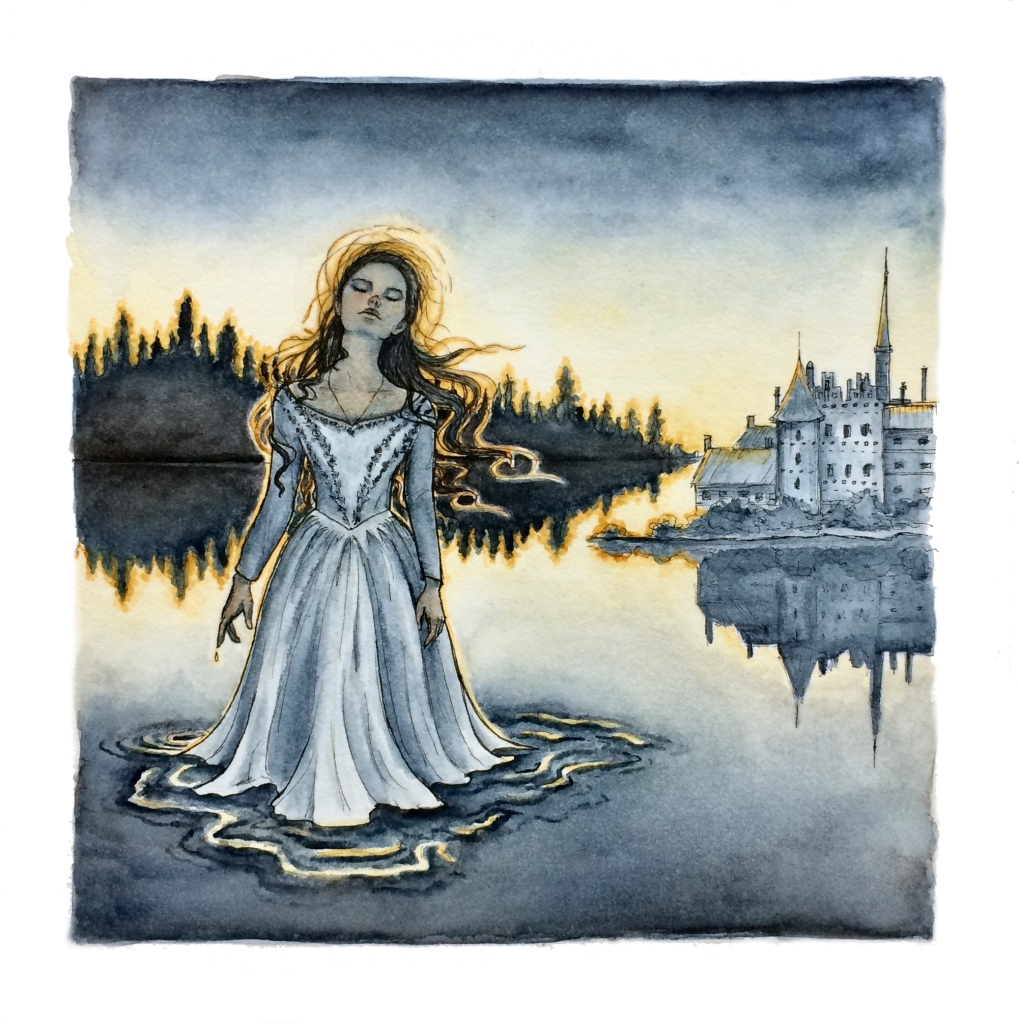
This week’s contribution to the Thresholds project is a work of beauty and mystery. In a pen and watercolor illustration, one of my classmates in the Theology and the Arts program, Karlee Lillywhite, explores the thresholds between sea/land, community/isolation, home/away…and more. I was Karlee’s partner for this project, so I gave her the following artifacts to start with:

  • Sea glass
  • Frost
  • Sound of bells

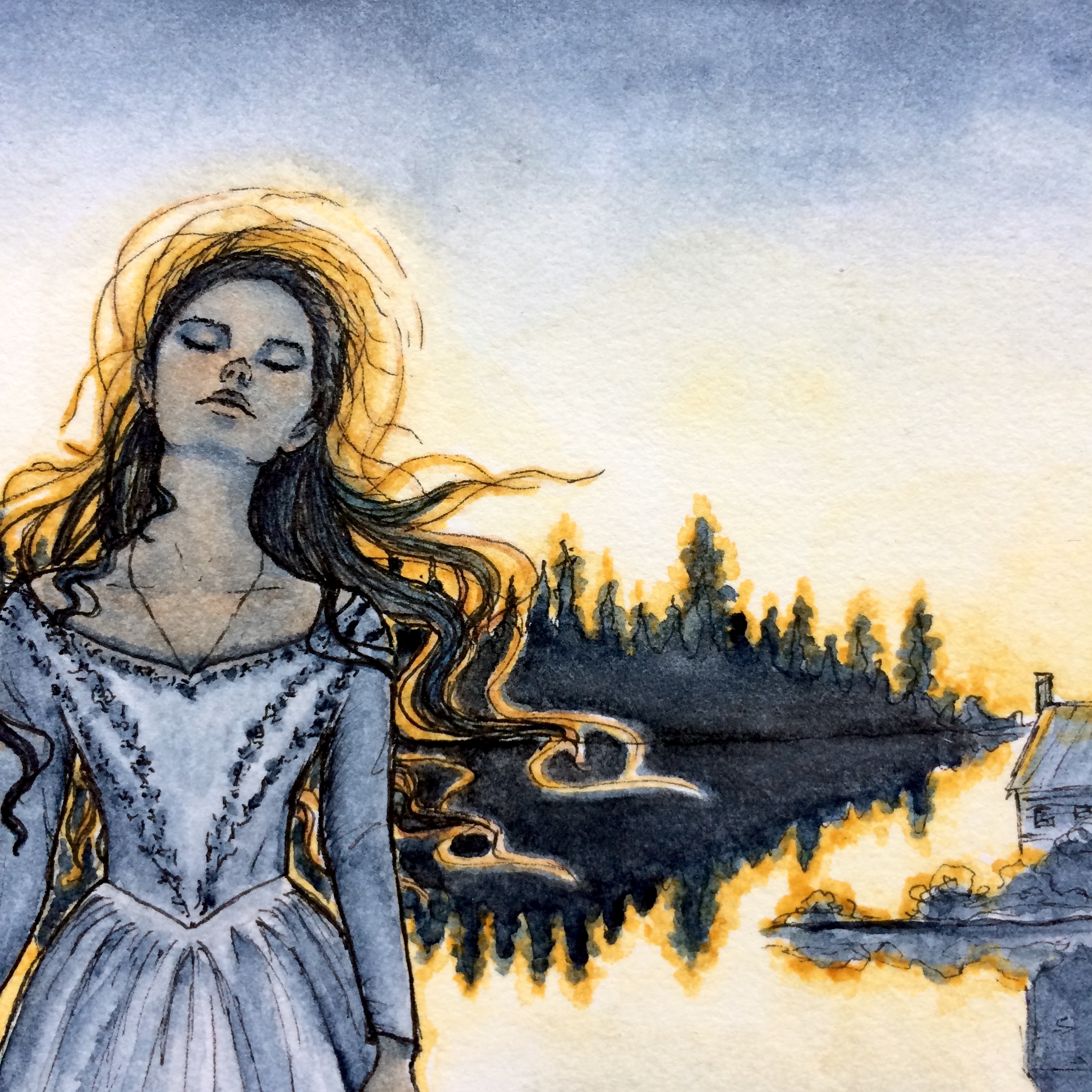
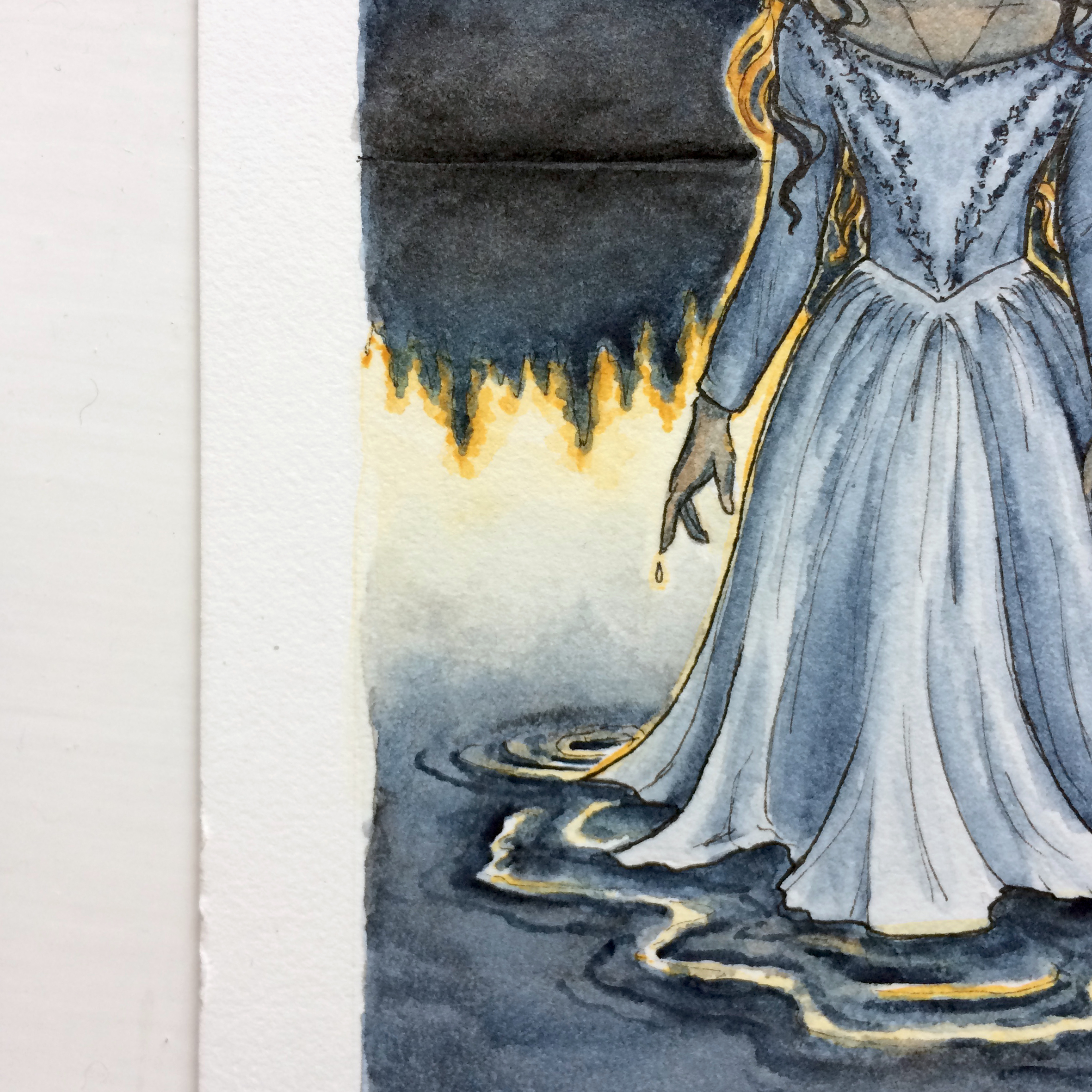
She responded with the exquisite work below. As a writer and not a visual artist or art expert, I can only gape in wonder at her fine, delicate composition, skillful use of color (especially gold!), and dreamy representation of sea and sky, land and the human face. Enjoy!

Between Homes (Agnete)

by Karlee Lillywhite
6″ x 6″ pen and watercolor work on illustration board

Between Homes (Agnete) watercolor

Karlee’s description:

This illustration is a scene from the story of Agnete and the Merman, which is a popular Scandinavian folk ballad about a human woman who falls in love with a merman and lives with him underwater. She has a family with the merman and lives happily with them for many years but one day, when she hears church bells ringing from up above, she becomes nostalgic for the land and wants to visit the surface. Once in the church building, she decides not to return to her underwater life. This painting depicts Agnete coming out of the water after her years below the surface. She is feeling the wind, breathing air, and hearing sounds clearly again for the first time as all the memories of her earth life and human identity come flooding back. An English version of the Danish ballad translated by George Borrow can be read here.

A closer look at certain aspects:

Karlee Lillywhite

Karlee Lillywhite

Karlee is a freelance illustrator who loves to tell visual stories that encourage experiences of longing and embodiment. Her work is inspired by women from literature and history and by the decorative motifs of medieval illuminated manuscripts and the art nouveau period. As a graduate student in the University of St Andrew’s Art and Theology program, she studies the devotional possibilities of illustration. You can follow her work and learn more about her process on her instagram and website.

Summer of Faerie: “The Decision” by Loren Warnemuende

August is hot. Humidity hangs heavy in the air and (some mornings) paints fog on the windows. The leaves have darkened from their fresh spring green and hang limp, shriveled. I’m writing this while sitting on the back porch steps, my feet on the dusty earth and brittle grass, as our golden retriever sits in the middle of a lawn chewing a stick. Crickets murmur in the woods. Just now, though, a cool wind just came running through the tree canopy with that delicious rustling sound like running water.

My Faerie research has lapsed (somewhat) as I work through summer reading for St. Andrews. On our Montana trip, however, I read Charlotte E. English’s delightful Faerie Fruit, a tale with shades of Eden, Christina Rossetti’s “Goblin Market,” and C.S. Lewis’s The Magician’s Nephew mixed in with small-town intrigue and told with enchanting prose. The first section was my favorite, but the whole story was a fascinating look at food and eating in Faerie (a branch of study I need to examine further), community and friendship, self-control and desire, love and choices.

This week’s Summer of Faerie post also concerns choice and desire. Loren Warnemuende, who wrote a retelling of “King Thrushbeard” earlier this summer, also contributed an excerpt from her manuscript, Exile. It’s the first book in a trilogy named Daughter of Arden which retells the Grimm Brothers’ tale of “Maid Maleen.” I’ve had the privilege of reading some of the first drafts of the series, and it’s marvelous – rich, exotic, compelling, and gripping at every turn. I hope to see them in print someday. Enjoy!

The Decision

by Loren Warnemuende

Cathedral interior
Photo credit: Loren Warnemuende

“Her Royal Highness, the Princess Maleen!” Minister Gooldon boomed. Echoes reverberated through the Hall, up against the arched stone ceiling and down across the glimmering windows.

 At the front of the Hall King Darrick rose, and the assembly turned toward the center where Maleen must walk. She swallowed. There were so many people watching. Three days before she had stood here alone with her father when he had given her the incomprehensible choice—marriage to Prince Jared of Dranneth, or sojourn in a tower. He said the tower was the only alternative to the marriage, and both were to keep her safe from the looming war with the barbarous Kalomenn. Maleen had begged him to consider other options—if only he would consider Prince Melanor of Pandor, the one she loved, who loved her!—but the king wouldn’t bend and now she had to announce her decision.

Maleen took a deep breath, fixed her eyes on her father, and swept toward him. Colors swirled along her sides and the path moved on and on. She felt she traversed the history woven into each of the tapestries lining the walls, back to the dawn of Arden. At last she reached the steps of the dais. King Darrick stepped down to meet her and took her hands in his.

They stood, brown eyes to brown. She did not speak, and tried not to look down, forcing her face to give no signs of her turmoil. The hush in the Hall was almost unbearable.

“And so, Maleen?”

His words were soft, but they permeated her being and flowed through the Hall. Maleen lifted her chin, but her gaze dropped.

“I choose the tower,” she said, and the weight of the stone pressed in around her. But it was the only option that would give Melanor enough time to come for her.

The king gripped her hands tightly and a chatter of voices rattled like tossed pebbles through the Hall behind her. The king’s hold loosened, and he sighed deeply. He stepped up to his throne, leading Maleen to her delicate copy of his massive seat before he sat down. He motioned to a guard who stood by the council chamber door. The guard stepped within, then emerged followed by a man and a woman. They approached the dais and bowed deeply to the princess and the king.

“Princess Maleen,” King Darrick said, “I would like you to meet Sage Granimor and Dame Marietta. Granimor, as you know, will build the tower.”

Maleen nodded in acknowledgment toward the man with the wind-grained face and bulky shoulders. The man’s frame seemed out of place in the ornate hall.

“I am honored to see to your safety, Princess,” Granimor stated, looking at her with piercing blue eyes. He carried his authority as a sage like a mantle. Maleen wondered how honored the man really felt for Granimor revealed nothing.

“And this,” Darrick continued, “is Dame Marietta, who will join you in the tower.”

Maleen jerked her head toward her father, then turned her full stare onto the woman before her. Someone to accompany her? The thought had not crossed her mind! She assumed she was in this on her own—how could her father impose such a fate on anyone else? Then she realized her father would never force someone to join her. But who would come willingly? Not, of course, Maleen reminded herself, that they would actually enter the tower, but what if…. No, the idea was unthinkable.

The woman stood quietly before her and Maleen wondered what far corner of the castle she had been found in. Her hair, dark brown except for some gray at her ears, was pulled back loosely from her tanned face. She, too, had keen blue eyes that were fixed steadily on the princess, and her mouth was firm, but not tight. A blue sash tied the waist of her brown linen gown and her back was straight.

She stepped onto the first step of the dais and took Maleen’s smooth hands into her rough ones. Her eyes were now level with Maleen’s.

“I am looking forward to serving you again,” she said smiling. Her voice was low and rich. 

Maleen gaped openly at the woman now. She was sure she had never laid eyes on her, and yet this peasant had the audacity to take her sovereign’s hand. Maleen closed her mouth, smoothed her face, and drew her hands away. Marietta, unperturbed, nodded slightly and stepped back to the foot of the dais.

Maleen saw her father frown faintly before he turned to her.

“Marietta has been a faithful member of this household since before you were born,” King Darrick explained. “She has worked in the library and kitchens, but it was she who nursed you your first two years.”

“Oh.” Maleen had no other words. She knew someone must have nursed her after her mother died, but no one ever said who. She’d never thought to ask. She stared again at this quiet woman who smiled at her with peaceful assurance.

The king waved his hand at the enigmatical pair, and with another bow they retreated to the council chamber. Maleen couldn’t take her eyes from the door where they exited. The rest of the Hall no longer existed.

Her father spoke beside her. “My dear, I hope you will continue your regular activities until the tower is built. It will be some months before it is complete.”

Maleen tore her eyes from the door but focused on her hands and didn’t look toward him.

“Yes Father, of course.”

He coughed slightly, and stood. She looked up into his face, trying to put away any feeling. The sight of his sad eyes, brows crumpled, and mouth compressed was too much for her. She stood quickly so she could avoid looking into his face again.

 “You may go now,” the king said, his voice low. And then, “I will try to call you in more frequently, my child.”

 “I—I thank you,” Maleen stammered blankly. She turned and stepped down the dais, moving toward the distant open doors, willing herself to remain calm and poised. She must be stalwart before her people. What would they think if she broke down now? And how could she let her father see how she felt? Let him show his pain! He should be anguished over sending his only heir and daughter into a prison. Besides, she thought, there’s no need for tears or tantrums! Melanor will come and take me away, far away, from all these people who pity me. She raised her chin again and left the hall with swift, unfaltering steps.

 She had expected her ladies would follow. They had said they would stand behind her, and she thought they’d want to be there, if only for the purpose of scrutinizing her initial reactions. She had looked forward to venting her frustration onto them. But no one followed, and when Maleen reached the bottom of the Hall stairs she realized she was alone save the stony sentinels of the King’s Elite. She caught her breath, forcing down an unexpected lump in her throat, then conversely welcomed the rushing wave of relief that she was alone. 

 Maleen strode toward Ramia’s Garden, thankful there would be no unwanted company at this time of year. She wandered the paths in silence, trying to think only of the muted colors of winter. Eventually she settled onto a stone bench hidden in the rose arbor and wrapped her arms about herself to ward off the evening chill. 

No roses bloomed, but the branches entwined the trellises, providing shelter from the cool winter breezes and possible prying eyes. The sun slipped behind the castle wall, but its ambient light cast a soft glow over everything. Maleen sat, drinking in the quiet, pushing thoughts away. Her eyes wandered, settling eventually on the brown stone of the Akklesia visible over the gardens. This building, a place of worship to the Mighty One, had stood for centuries here in Ardenay. It was a symbol of hope for the people—a center. It was only a small Akklesia, structured for the worship of castle inhabitants. Every castle and large town in the country had an Akklesia, most far more grand than this. But this one was significant because it was the first. Arden’s first king and queen had built it with their own sweat and blood, forging a core for their young kingdom. It was they who lit the first Light, the eternal flame that burned on a pedestal in the Akklesia, representing the Mighty One’s constant presence.

 And what was the Mighty One’s perspective on Maleen’s situation now? Wasn’t he worshipped and honored because he protected his chosen people? Maleen was from the line of Arden’s kings and queens—the blood of the firsts flowed through her. Why didn’t the One Who Saves reach down and change her situation now? Why had he even let it occur?

No voice answered her questions; she hadn’t expected one. Instead the clear tones of the Akklesia choral girls rose, singing their evening hymn of praise. The single line of notes climbed sweetly into the clean air, dragging with it the lump lodged in Maleen’s chest. It rose into her throat and then mouth, and with it came the tears she had repressed so fiercely. A final ray of the sun lanced over the castle wall catching the roof of the Akklesia, and the water in Maleen’s eyes magnified it so it seemed to ignite and consume the building, annihilating hope. Without further care for appearances, Maleen lowered her head and sobbed.

Loren Warnemuende

When she was in fourth grade, Loren won a story-writing contest and decided that she’d grow up to be a writer. Since then God has led her into many roles including wife to her Renaissance man, Kraig, and mom and teacher to their three kids. Loren also teaches Worldview and Bible to high schoolers in a homeschool co-op, and adults at church. Through all these roles writing has been a source of hope and a way to share the stories and big ideas that fill her mind and heart. Loren lived most of her life in Michigan, but now calls East Texas home. You can find more of her sporadic writing on her blog Willing, Wanting, Waiting…..