Five years ago, I had a long-ish commute to my job: about 50 minutes. I drove past long stretches of woodland that turned golden-green, fiery red and orange, silver-green, and gray throughout that year; tiny grave plots on lonely hillsides; fields of long grass and cattails rustling in the wind; red barns and grazing horses. I knew every highway exit and every pothole. I desperately wanted to fill up my mind with good things for the empty hours of computer work, so I listened to a lot of podcasts.
As I listened to a steady stream of news, artistic musings, entrepreneurial advice, motivational tips, and other eclectic content, I dreamed of starting my own podcast. “Dreamers in Dull Jobs” or “CommuterPlay,” I imagined as the title: “a podcast for the thoughtful office worker.” The list of ideas on my phone had topics like essays by G.K. Chesterton (thrilling and hilarious and as comforting as a hearth fire in a pub in winter) and the poetry of Robert Frost (bright and intricate as a snowflake). The topics would be exciting, fascinating, transcendent things that would fill commuters with hope and wonder as they drove cars, rode subways, or walked into drab office buildings: constellation mythology, metaphysical conceits, detective stories, legends of the sea. I wanted to give other people the soul-food I needed.
I knew, however, that I had very little to talk about on a podcast. So I waited.
Years of continued commuting; moving; COVID; grad school in Scotland; more moving and settling; reading, dreaming, thinking, healing, growing. There was never a perfect time to do it, and the obstacles – the intimidation of actually recording my voice and sending it into the world, as well as the hard work and technical demands – always loomed. But I decided to try it this summer.
As Tennessee grew green and gold and steamy with humidity, with crimson wild strawberries in the grass, white and yellow honeysuckle in the woods, the rubber-band thwang of the bull frog in the pond, and deer stepping lightly in the shadows, I wrote and researched. It is a lot harder to write a podcast script than I thought, especially since I have the tendency to ramble, with plenty of “um”s, “ah”s, and (my particular vice) “so”s. But my researching and pondering has led me to some beautiful things.
The Podcast’s Topic
The first episode explains the topic and scope more fully, but in summary, I chose “fairy tale retellings in the light of Scripture” as the topic. I love fairy tales and want to write fairy tale retellings myself, so this is a rich, plentiful subject area to work in. As my approach or angle of perspective, I chose to use Scripture as my interpretive framework or lens for truth and beauty. I will look to the Bible as the sourcebook for how a fairy tale retelling should approach good and evil, sin and grace, quests and spells, impossible tasks and glass slippers and castles swallowed in briar-roses. Referencing Scripture this way has led to me to research some fascinating questions, such as “what role does glass (the material) play in Scripture?” and “how does Scripture portray sisterhood or brotherhood?”
The Podcast’s Format
Podcasts that are conversational and tell stories are my favorites. I plan to have as many guests as I can, but as that requires a lot of planning, I have a mix of guest and solo episodes. Because it’s harder to listen to one person’s voice for a long time, I am keeping the solo episodes short – no more than 30 minutes or so.
I will open by reading aloud a particular fairy tale, and then discussing how an artist can approach specific ethical issues and images like the helpful fox or the candy house by referencing Scripture.
The Podcast’s Name and Art
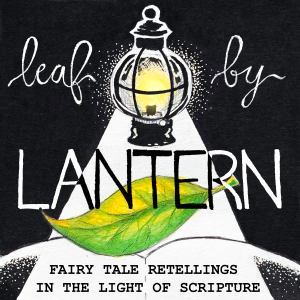
Naming things has never been my strength. After some anguished brainstorming, self-doubt, and wavering, I asked for help. A lovely writer-friend, Reagan Dregge, came up with a beautiful one: “Leaf by Lantern.” The name is a nod to J.R.R. Tolkien’s story, “Leaf by Niggle,” and his concept of the canon of folklore as “The Tree of Tales.” I wanted to make it clear that Scripture is the eternal, transcendent, God-breathed work, and fairy tales are beautiful but man-made and therefore fallible. The idea is that Scripture is the lantern (Psalm 119:105) for the Tree of Tales, helping us distinguish truth from lies and appreciate beauty all the more. Two excellent artists, Clare and Evie Warnemuende, created the exquisite show cover art for me, saving everyone from the dreadful results of me attempting to do so on my own using Paint.
I hope this podcast accomplishes at least one goal: reminding people of the goodness of the Great Story, the true Fairy tale, the God who “delivered us from the domain of darkness and transferred us to the kingdom of his beloved Son.” It has already done so for me.
Access the podcast here, on Apple Podcasts, or on Spotify.









 Stories of Yearning