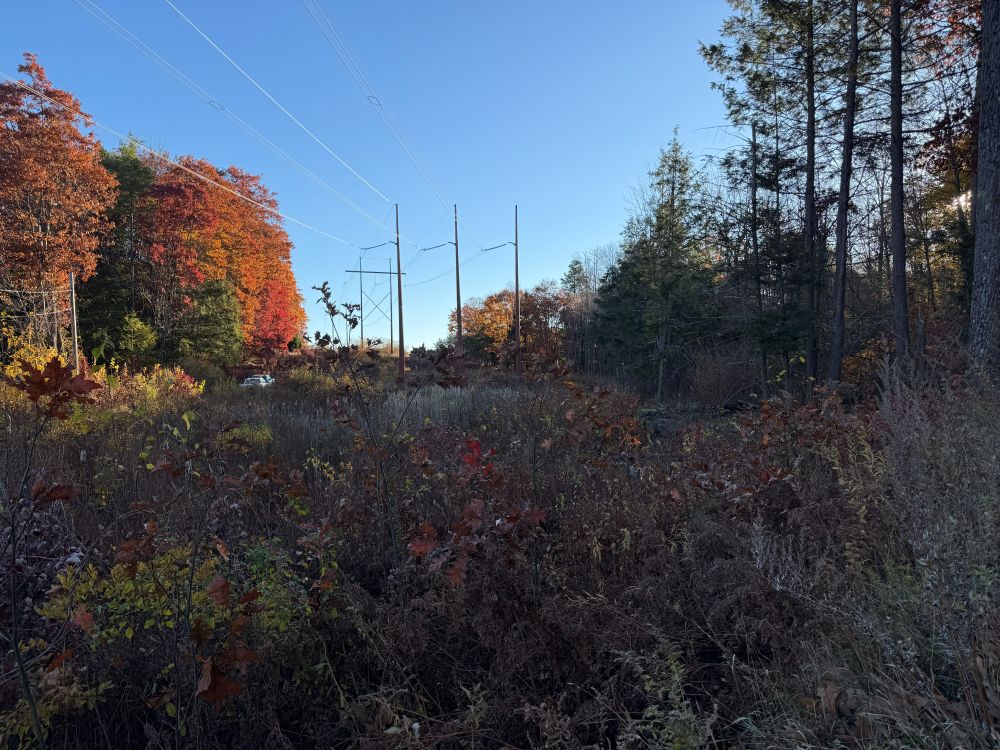
This fall was the busiest season I have had for a long time, maybe since the rush of reading, studying, part-time technical writing, and hiking adventures of grad school. The outdoors were radiantly beautiful: scarlet, crimson, saffron, and gold in the trees, morning light glimmering on the rivers, seagulls and solemn Vs of Canada geese overhead, and the crunch of leaves underfoot.
Now, most of the leaves have fallen, and the evergreens look somber and determined among the other gray and brown tree trunks. Invasive bittersweet, a dangerous tangle with bright red berries encased in yellow, is one of the few bright spots. In the mornings, I can watch blue jays, red-headed woodpeckers, black-capped chickadees, white-breasted nuthatches, and eastern bluebirds wing among the trees and perch on my neighbor’s bird feeders.
I realized that this fall, in all its busyness, has been about home and homecoming in several distinct ways.
My New Home: The Joys and Anguish of Moving
This fall, I moved into a new place. It was just as chaotic, difficult, educational, stressful, exciting, and bewildering as I expected, and a lot more. My past moves have taught me how emotionally draining it is to have your possessions packed in boxes and to be in bare, empty rooms without furniture to soften them. This one was disruptive and transformative on another level because I repainted several rooms, discovering for the first time the intricate details of primer and painter’s tape, angled brushes and rollers, cutting and rolling, palettes and undertones.
Almost a decade ago, I was in a creative writing class in which the teacher talked about the power of specific, physical details in prose and poetry. I drove nearly an hour each way to work then, and felt very detached from the physical world: getting up in the morning, driving to work, sitting in a cubicle in front of a computer, and driving back. He challenged me to explore how I was still connected with the physical, material world even when so much of my days were spent in a car or at a work desk. I do remember drinking in the seasonal changes on those long commutes: realizing that sumac leaves are the first to burn in the fall, and that cooling air made mist curl from the rivers in the mornings.
Now, I feel even more disconnected from the physical world as I work remotely, and my conversations with coworkers are mediated through a screen. But I discovered that the physical challenges of moving and house improvement projects are a great counterpoint to sitting at a desk: carrying awkward and heavy objects up stairs, popping open a paint can with a screwdriver, carefully running an angled brush over a tricky spot, smelling the fresh, unnatural odor of paint, unrolling rugs, and cutting tape on boxes.
I think all remote workers should do a home improvement project or intensive yardwork once a quarter, just to see, hear, smell, and touch something real. It forces you to feel your own weakness, clumsiness, impatience, and ignorance. It also gives you the warm satisfaction of a job well done: a freshly painted wall in a color you like, furniture to transform a room from empty to cozy, lightbulbs that cast the right temperature of light. Working on this home reminded me that I am mortal — fragile, and quick to get tired — but I can change the world around me with my feet, fingers, eyes, and voice.
Homemaking is a beautiful, arduous, and long-term work. I can’t rush through it the way I wanted to. I want my new home to feel finished, polished, and perfect, but fixing all the foundational things like outlet covers and finding the right furniture will take time. I hope I enjoy it.
A Story Without a Home: My Thoughts on the Upcoming Film Version of The Magician’s Nephew
This reflection is too late to be part of the initial buzz around the revealing of Greta Gerwig’s plans for her adaptation of The Magician’s Nephew, but I was glad for the extra time to think. This story is very close to my heart, and I am saddened by some of the decisions Gerwig announced: casting Meryl Streep to play a beloved, mysterious, powerful character who is fundamentally male and masculine; yanking the story from its Edwardian setting, which is part of its bones and blood, into the 1950s (which, as many have pointed out, doesn’t fit the timeline of the other books); choosing rock n’ roll for the music and the tone, which doesn’t fit the book’s atmosphere at all.
I don’t want to spend more time ranting and raving than I need to, or act like this movie could ruin Narnia. It can’t. I look forward to 2050, when the copyright expires and other artists and directors, hopefully some who really love this book and can do it justice, will be able to create live-action or animated film versions. But I wish Greta Gerwig had found ways to honor C.S. Lewis’s story while putting her own unique spin on it.
I thought about that: how could you adapt this story for film with imagination, good taste, and respect for the original work? I actually did my Extended Essay, a 4,000-word paper for my senior year of high school, on how a set designer could tackle a play version of The Magician’s Nephew, so I’ve had it in the back of my mind for years. Here are a few ideas:
- Embrace the real era — The 1950s and post-WWII era is the wrong atmosphere and wrong tone for this story, like putting scrambled eggs on creme brulee. I felt the same about the 2015 Wrinkle in Time movie, which dragged the story from Cold War Connecticut into modern-day Florida — it did not work. Worse, this change throws off the timeline of future movies: how could Digory be an old man in World War II if he’s a child in the 1950s? Instead, a director could embrace the late Victorian/Edwardianness of this tale by leaning into the E. Nesbit and Sherlock Holmes atmosphere introduced in the first few sentences. Add some allusions to The Phoenix and the Carpet and Five Children and It that will work even for audience members who don’t know those books. Use some fun details from E. Nesbit’s work, like the flying carpet. Throw in a cameo of Sherlock Holmes in the Earth scenes (now that could be fun). Make the fashion, language, and technology fit the original Edwardian setting, post-Victorian and a golden era before World War I, the magical time of Beatrix Potter, The Wind in the Willows, and Peter Pan.
- Expand on what Uncle Andrew reveals — When he’s telling Digory how he made the magic rings, Uncle Andrew drops some wonderful hints that a film director could pick up. The lost island of Atlantis — what if Atlantis is connected with Charn somehow? That could be a whole prologue scene and deep background for Digory’s family. He also describes a wicked fairy godmother named Mrs. Lefay, like Morgan Lefay of Arthurian legend. The story could explore more about her (and maybe Meryl Streep could play that character). Lewis wrote and abandoned an unfinished prequel called The Lefay Fragment that a film adaptation could pick up and use, with a lost thread about Digory being able to communicate with animals.
- Worldbuilding with Charn, Narnia, and the Wood Between the Worlds — There is so much fun a good storyteller could have with these worlds. Charn is a fallen empire like Babylon, Rome, Assyria, or Greece. A set designer and costume designer could have a field day figuring out the architecture, colors, clothing styles, and geography of this ruined, cruel, splendid world. Narnia should feel like the polar opposite as a young, fresh, innocent place. I think it would be delightful to film the Narnia scenes in the Mourne Mountains of Northern Ireland, where Lewis said he imagined Narnia. I traveled there in 2021 and it was emerald-green, misty, mysterious, and lovely. You would have to figure out how to film around all the rain, though.
- Planet Narnia and the spirit of Venus — In his book Planet Narnia, Michael Ward argues that each Narnia book has the “spirit” or atmosphere of each of the seven medieval planets. The Magician’s Nephew is infused with the spirit of Venus: creative, vibrant, fertile, life-giving, and abundant. Set designers, musicians, choreographers, and a great cast could all work together to embrace that vision and give audiences a delicious taste of it.
- So much more — This list is already too long, but an adaptation could explore Uncle Andrew’s archetype as the mad scientist like Dr. Jekyll or Victor Frankenstein, the medieval tradition of “the music of the spheres,” the carnival of talking animals, Digory’s mother, Frank the cabby and his wife Helen, or so much more.
The Magician’s Nephew is such a rich, colorful, light-hearted, deep-souled story. I think it deserves better than rock n’ roll (with respect for those who love that genre, it’s just not right for this tale!), a feminized version of a majestic male lion, and timeline confusion. I look forward to future adaptations by people who will honor Lewis’s creation in their own unique ways.
Homecoming Conference 2026: A Call to Fellow Exiles
At the beginning of November, I went to a conference in Boston called “Homecoming,” hosted by Restore New England. I hadn’t heard of the organization until this summer and wasn’t sure what to expect. The description sounded very good, all about encouraging people to be missionaries in New England, so I was hopeful.
It was incredible, the best conference I have ever been to. The keynote talks focused on the theme of living as strangers, exiles, and pilgrims from Hebrews 11-13, people who are seeking a homeland and will never feel secure in this world. They outlined the spiritual and theological history of New England and how we got here, after the Pilgrims came seeking religious freedom and the Puritans tried to set up a theocracy. They read from Pilgrim’s Progress, the part where Christian nearly wanders away on the bad advice of Mr. Worldly-Wise and is lovingly scolded by Evangelist. They had breakout sessions on how the gospel speaks to singleness and to marriage, and what ministry looks like in a rural/suburban vs. urban context. Speaking Biblically to topics like those requires a lot of research and study, but each session speaker did it beautifully.
The sessions were some of the most loving, gentle, passionate, humble exhortations I have ever listened to. I filled my program with scribbled notes and have a lot of thinking and praying to do about my role as a proclaimer of the gospel here.
Home-seeking; home-making; homesickness; homecoming. I did not expect it, but this fall, itself a season of change, is teaching me a lot about the labor and longing of home as I live here in this world, in hopeful exile.

