

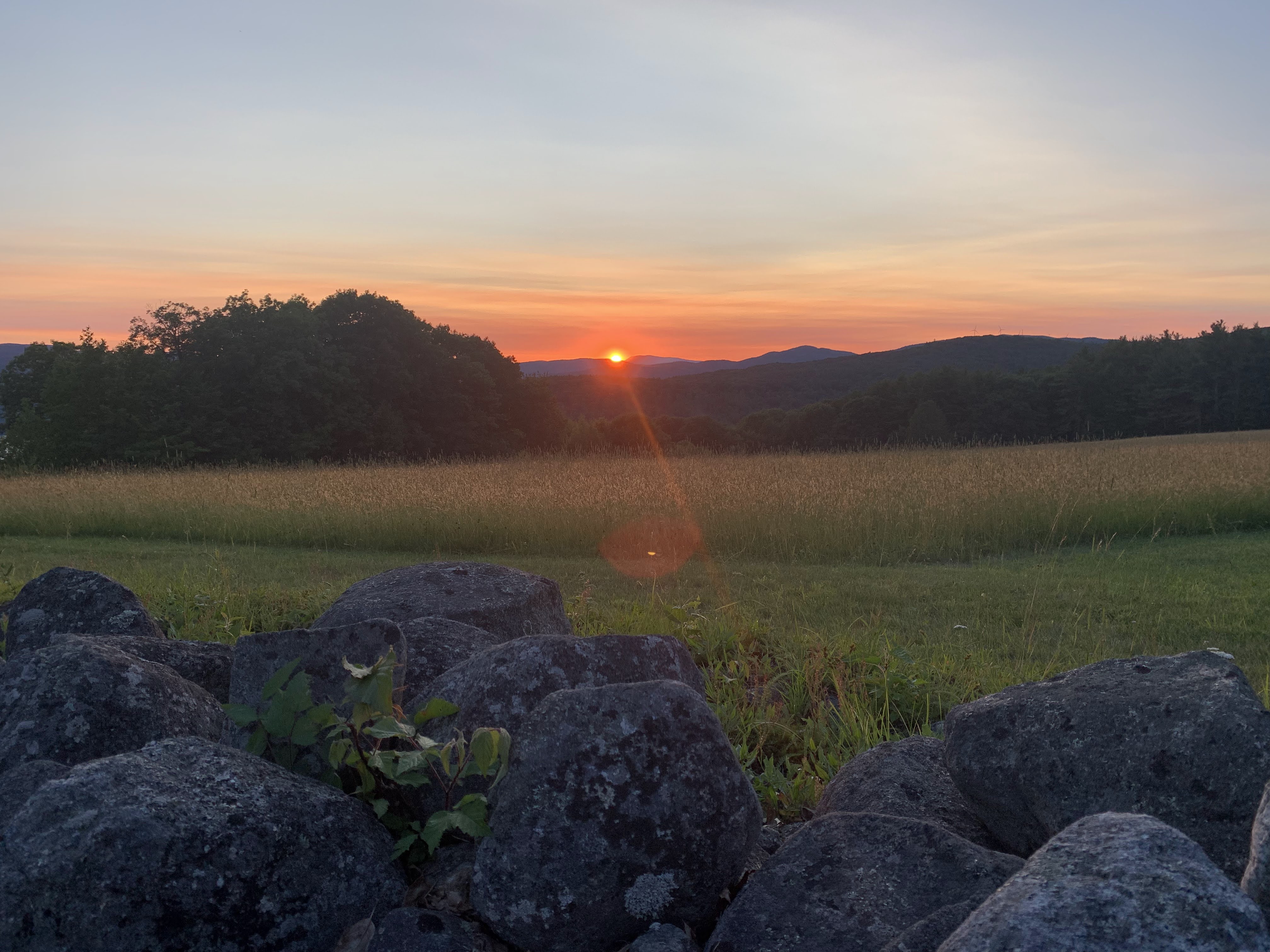
Summer days were just a magazine, a magazine, a magazine . . .
Cutting grass for gasoline
For gasoline, so I can see ya soon . . .
“Dandelion Wine” by Gregory Alan Isakov
Gregory Alan Isakov is one of the best living poets I know of. His metaphors are rich, sweet delights that summon moods and moments, dreams and memories like spells. In “Dandelion Wine,” he captures the lazy, wistful, sultry days of late summer in that lovely image of dandelion wine – the golden flower-weeds that dot the green grass, the sleepy pleasure of drinking in the sun and the quiet of long days.
It’s getting towards late summer now. Air that was heavy with humidity is now soft with cool breezes; the oaks bear little clusters of acorns turning from green to brown; dainty Queen Anne’s lace and radiant goldenrod are flowering in the ditches; the whir of cicadas and cooing of mourning doves sounds dreamy and content. After a tumultuous year, I’ve found that returning to things I love like Isakov’s music, T.S. Eliot’s Four Quartets, Lewis’s Chronicles of Narnia, and the Nancy Drew books is deeply comforting. It has been harder lately to feel that “yearning” that I made the theme of this blog — that deep, sweet longing for the presence of God — but good old stories, songs, and poems stir up the memory of it. Best of all are Psalms like Psalm 34 in its tenderness and Psalm 36 in its joyful wonder; I find the thirsty roots of my soul stretching into those passages.
Psalm 36:7-9 —
7 How precious is your steadfast love, O God!
The children of mankind take refuge in the shadow of your wings.
8 They feast on the abundance of your house,
and you give them drink from the river of your delights.
9 For with you is the fountain of life;
in your light do we see light.
After spending last summer pouring over fairy tales for the Leaf by Lantern podcast, I decided to mix things up this summer and try to write a historical fiction/mystery set in New England in the 1950s. It’s definitely challenged my research skills. I want to summon the music of the past in minute detail: the use of suntan lotion vs. sunscreen, for example, the swish of circle skirts, the necessity of starching and ironing everything, the shadow of the Korean War, and the use of telegrams/radio/letters for communicating and spreading news. Great historical fiction authors like Eloise Jarvis McGraw and Rosemary Sutcliff managed to capture the smells, tastes, sounds, and textures of long ago in gorgeous detail, and I want to imitate them, but it takes a lot of digging to get there.
Wanderings in Faerie
But I still want some fantasy in my life. I finished Junius Johnson’s “Summer of Fairies” course with a rereading of George MacDonald’s Phantastes – a weird, wonderful song of Romanticism and fairy tale beautified with a Scriptural vision of redemption. We’ve explored the nature and characteristics of Faerie, Fairy Land, Elfland, or whatever others call the fairy world and what makes it fascinating and dangerous.
One thing that’s surprised me in this course is realizing that the land of Faerie is perilous for the reader as well as the character. In a world where normal rules don’t apply and new, terrifying ones spring up, like “don’t tell anyone your true name” or “don’t eat any of the food or you’ll get stuck here,” you want a loving, wise guide like Tolkien, MacDonald, or Lewis with you. Tolkien, MacDonald, Lewis, and storytellers like them witness to the Lord who is Good Shepherd. He sees every lonely wanderer, every lost soul who gets caught in a trap of their own making, and offers a safe haven of forgiveness. I read the ebook version of Tolkien’s short story “Smith of Wooten Major” with Pauline Baynes’s bewitching illustrations, and that sense of sovereign mercy even in a perilous realm is so beautiful:
But he [the main character, Smith] had business of its own kind in Faery, and he was welcome there; for the star shone bright on his brow, and he was as safe as a mortal can be in that perilous country. The Lesser Evils avoided the star, and from the Greater Evils he was guarded.
“Smith of Wooten Major” by J.R.R. Tolkien
Authors who don’t have that Scriptural view of reality and shepherdly love for their readers can lead you down some dark roads. Faerie is, by nature, inexplicable and unmappable, but heaven’s love and justice are just as sovereign there as everywhere else.
Saturnine Stories in the Light of Scripture
I’ve thought more about stories that lead their audiences down dark roads from a recent conversation with my dad. He asked me if the newish Marvel show, “Secret Invasion,” featuring an older Nick Fury battling a new threat, was any good. I had tried it out a few months before and didn’t like it.
“It’s kind of sad,” I explained. “Nick Fury is older and keeps making mistakes, and everyone keeps reminding him that he’s not as strong and smart as when he was young, and some really lovable characters die, and it just feels like all the good times are gone and there’s nothing left. I don’t like those kinds of stories.”
My dad thought for a moment. “Was it saturnine?” he asked.
I gaped at him. We’d both read Michael Ward’s Planet Narnia years before; my dad was referencing Ward’s argument that the seven books of Lewis’s series are written in the spirit of the seven medieval planets. Each Narnia book has the tone, atmosphere, and resonance of each planet. It’s too long a thesis to describe here, but Ward argues that The Last Battle is written in the spirit of the planet Saturn: a spirit of decay, loss, old age, and death, good times past. Google “saturnine” and you’ll find various definitions of a person or mood that is cold, gloomy, forbidding, bitter, and sardonic. Ward explains how Lewis’s Christian vision reveals good, redemptive aspects of Saturn (read the book to find out more about that) but a saturnine story without that Scriptural hope is unreasonably depressing. My dad was dead center: “Secret Invasion,” or at least, the first few episodes, is saturnine.1
Remembering Michael Ward’s book reminded me of how much hidden meaning lies in stories. Stories are visions of the world; every word and sound, character portrait, image and plot point has a spiritual dimension. Many of the classics I read in school like John Steinbeck’s Of Mice and Men, Kamala Markandaya’s Nectar in Sieve, Aldous Huxley’s Brave New World, or John Knowles’s A Separate Peace are exquisitely crafted, but they leave the reader with a tiny fragment of hope at the very most.2 As I reflect on that part of my education, I feel more and more how wrong it was to give students a picture of victimhood without justice and suffering without hope. It would be easy to go to the opposite extreme and celebrate happy stories that have no darkness at all — but that wouldn’t be true to reality, either. The best stories look forward through pain to the God who will right every wrong and “wipe every tear from our eyes” in the New Creation.
This will be my struggle as a writer: crafting stories that reckon with darkness while witnessing the victory of light, that reflect the redemptive shape of the gospel without “skipping over” the sad parts (as I wish I could skip over the sad parts of life). Scripture will help me in that, reminding me that Jeremiah’s lament is just as real as Nehemiah’s rebuilding of Jerusalem; that David’s sorrow over Absalom was as much a part of his life as his victory over Goliath; that Good Friday was necessary for Easter Sunday; that the New Jerusalem promises healing. In this “magazine” of golden late summer days and earthly peace, I look forward to the peace of the final victory, of drinking from the river of God’s delights forever.
Notes
1 “Secret Invasion” is a Marvel show, and Marvel stories usually work out to a happy ending, so I’m guessing that there is a turning point where things get better. I just didn’t want to sit through all the sad parts.
2 These books are classics for a reason, and I know I’m oversimplifying them by talking about them so briefly. They are extremely well-written and testify to important truths about the world. But all four of these books culminate in a significant death, and I don’t think they echo the gospel’s forgiveness and promise of resurrection. To be fair, my high school also assigned us Ray Bradbury’s Fahrenheit 451, Mark Twain’s The Adventures of Huckleberry Finn, and even Shakespeare’s tragic “Romeo and Juliet,” which do have redemptive hope.
 Stories of Yearning