

Two Sides of Yearning: Adventures and Koselig in Norway

The sweetest thing in all my life has been the longing — to reach the Mountain, to find the place where all the beauty came from — 

C.S. Lewis, Till We Have Faces

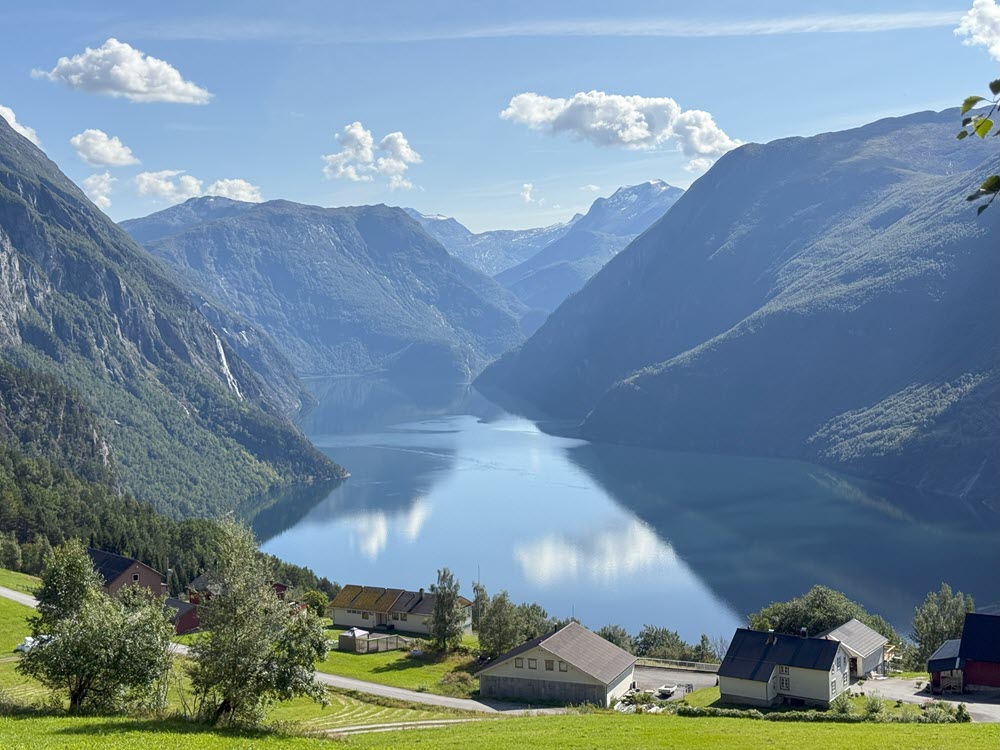
It was exactly the kind of place my childhood self dreamed about: gigantic mountains thick and green with pines, firs, and birches; waterfalls tracing the steep slopes like silver ribbons; glimmering fjords that reflected the bright blue sky and dark blue mountains; white-tailed eagles wheeling through the clouds; cottages and farmhouses clustered in emerald valleys; wandering sheep with bells around their necks; purple heather with leaves burned crimson with autumn. 

Norway embodied many of my old fantasies. There were cottages tucked high in the hills, lonely and quiet, that my introverted self would have loved to hide in. (My older, more practical self stops to consider things like steep, icy roads in winter, the difficulty of running errands, and the risk of loneliness). We hiked down a path that led behind a roaring waterfall — no treasure-caves hidden behind there, sadly, but it still felt magical.

There were sailboats like a flock of white birds on the shimmering fjord at dusk; green islands connected by long bridges and long tunnels; a lighthouse stained blazing red-gold with sunset. The souvenir shops are designed for tourists who love adventure and at least the vague concept of Norse mythology: they all had Viking-themed magnets and mugs, Fair Isle sweaters, and stuffed reindeer, moose, and wolves. On sunny summer days, with the wildflowers in full bloom and winter a thousand miles away, it felt like the perfect place for adventures, quiet, and dreaming. 

But Norway is cozy as well as grand. The untranslatable word “koselig” captures the cozy, safe, familiar, warm, intimate, homey feeling of home gatherings during the long Arctic winters. From the sound of it, koselig means fleece blankets, crackling hearthfires, storytelling, hot drinks, and deep talks that go long past midnight on nights that last longer than days. 

World War II and the Torches in the Night

In Oslo, we visited Norway’s Resistance Museum, which chronicles the dark years of occupation by the Nazis in World War II. While much of the material was in Norwegian, italicized English told the stories of the desperate, doomed struggle in the spring of 1940 to stop the German invasion; the betrayal of Vidkun Quisling, the head of the Norwegian fascist political party who collaborated with the Nazis and received the lasting hatred of his own people; arrests, imprisonment, suppression of free speech, rations, fear, and the horrific seizure of Norway’s small Jewish population; the courage of many who smuggled people to Sweden, hid fugitives in their cellars, printed illegal newspapers to spread truth and hope, and planned dangerous acts of sabotage; and finally, the joy of deliverance. 

So many plans failed. A few succeeded, most famously the sabotage at the heavy water plant that delayed the Nazis’ development of the atomic bomb and changed the course of the war, but many brave, ordinary people were caught. Some were executed. 

The hope of Great Britain stood out like a flame in the night. After so many countries capitulated to fascism, were conquered by overwhelming force, or went neutral, Winston Churchill’s “we will never surrender!” held back the tide for a year and a half alone, until the U.S. joined the war after Pearl Harbor. It was a refuge and training ground for the resistance. Many Norwegians fled to the UK, received training, and returned to try to free their country. 

World War II still feels so close, though not too long from now, it will be a hundred years past. The candle flames that people held up against that great dark, and the mighty faith of people like Corrie ten Boom and Dietrich Bonhoeffer, are startling in their beauty. 

A Yearning for Adventure vs. Koselig

When I started writing on this blog, I named it “stories of yearning” because the word “yearning” best captured that wild, mysterious, wonderful feeling that good books gave me. It’s akin to the feeling that C.S. Lewis called sehnsucht or Joy in his book Surprised by Joy: “an inconsolable longing” that he eventually identified as a sign of our longing for heaven. It’s also similar to the experience that L.M. Montgomery called “the Flash” in her Emily of New Moon series: 

It had always seemed to Emily, ever since she could remember, that she was very, very near to a world of wonderful beauty. Between it and herself hung only a thin curtain; she could never draw the curtain aside—but sometimes, just for a moment, a wind fluttered it and then it was as if she caught a glimpse of the enchanting realm beyond—only a glimpse—and heard a note of unearthly music. — L.M. Montgomery, Emily of New Moon

My sense of yearning isn’t exactly sehnsucht. The sweetness stirred up in me by books like The Castle of Llyr and A Wind in the Door was less painful than what Lewis describes, more excitement than grief. I loved it. It fed my desire to travel and see the world: the castles and cottages of Scotland, the emerald hills of Ireland, and the rainbow of tulips in Amsterdam. 

In the past few years, my yearning for adventure has waned. The turmoil of the pandemic, a few moves, a lot of change, and the practical drudgeries of travel like red-eye flights threatened to swallow up that longing. I tried to summon it back, but as Lewis found when he tried to manufacture sehnsucht, you can’t recall feelings at will.

Now, I’m wondering if that sense of yearning has just become inverted. Part of me still longs for faraway, glamorous places, but now I dream even more about near, safe, cozy, and sheltered spaces: hearthfires, deep friendships, and the stability you only get when you live in a good place for a long time. Instead of adventures like those in Treasure Island or The Silver Chair that take me to wild moors or deserted islands, I’m yearning for koselig. 

Yearning can be an idol, if I let it; something that keeps me discontented and restless. At its best, it’s a hope for the joys beyond this world and the God who made all good things. 

The wondrous thing is that the fulfillment of all longings, to be with the Lord in heaven forever, completes both sides of yearning, the splendid and the snug: 

Psalm 36:5-9 (ESV)
Your steadfast love, O Lord, extends to the heavens,
your faithfulness to the clouds.
6  Your righteousness is like the mountains of God;
your judgments are like the great deep;
man and beast you save, O Lord.
7  How precious is your steadfast love, O God!
The children of mankind take refuge in the shadow of your wings.
8  They feast on the abundance of your house,
and you give them drink from the river of your delights.
9  For with you is the fountain of life;
in your light do we see light.

I love how this psalm captures it all: the vastness of God’s goodness, higher than mountains and deeper than the sea; the sweetness of His hospitality, inviting us into His home, becoming our true home; the closeness we can have with him, feasting from His abundance, drinking from the river of delights, and seeing light in His light. 

Adventure; quiet; glory; rest; faraway; home; mighty mountains; safe harbors; spectacular sunsets; fragile wildflowers; the Lord God, Father and Maker, fulfills all these desires more beautifully than we can imagine. 

Summer of Faerie: Lanterns in the Night

The summer heat has overcome most of the flowers, though the orange tiger lilies and small pink tea roses are still holding out. When I walk by the river, ocean breezes just barely disperse the steamy humidity.

This week’s Summer of Faerie post probably should have been the introduction to this blog series – a look into fairy tale scholarship from a Christian perspective. However, I didn’t have it ready when I started in late May, so it provides an academic interlude after the delightful prose and poetry other writers have contributed.

Many wise scholars have walked this path before me, exploring the relationship between Biblical truth, faith, and the space between once-upon-a-time and happily-ever-after. This essay explores a few of their thoughts and my own experiences in the perilous realm of Faerie.

Fairy Tales as Lanterns in the Night

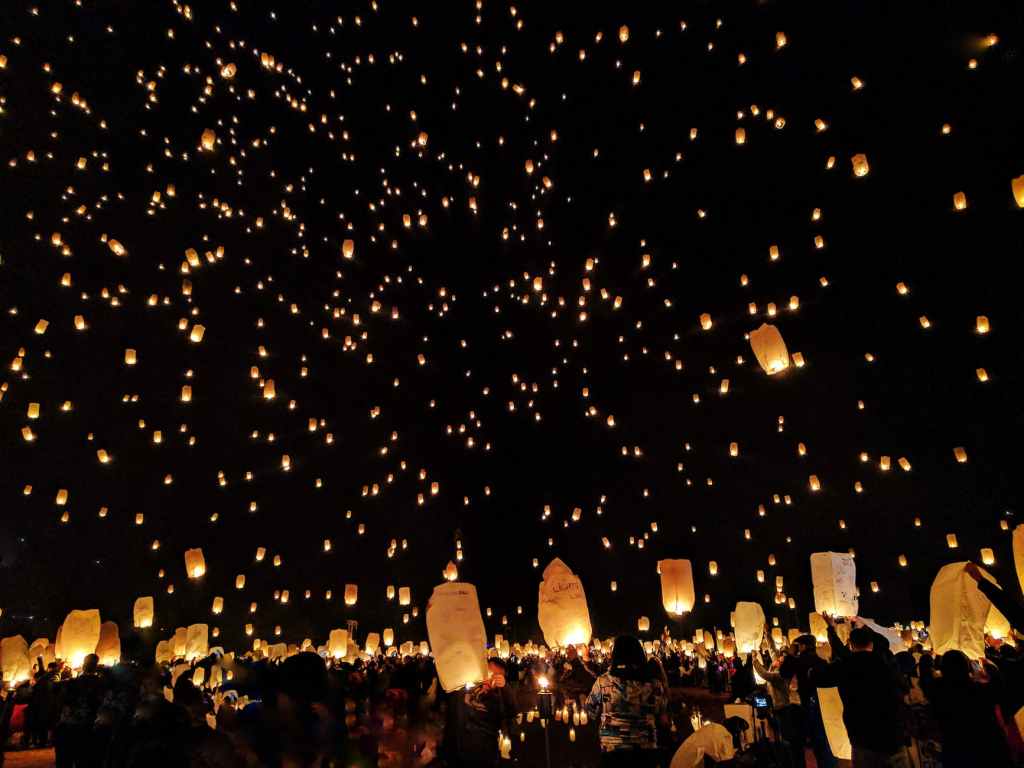
Lanterns
Photo by Abby Kihano on Pexels.com

In the Cape Cod village where I grew up, the library had previously been the schoolhouse. It was a quiet, sunny building with gleaming wooden floors, framed Sailor’s Valentines made of seashells, and glass cases of wooden ship models. They kept fairy tales, fables, folklore, myths, and legends in the corner of the Children’s wing.

I returned to that corner over and over. These books filled my mind and fueled my own stories with images: golden palaces and dark woods, beautiful princesses and wicked witches, ravenous dragons and friendly enchanted frogs.

While I loved the excitement of these stories, I found that the more-developed characters and complex plots of fairy-tale-related books like C.S. Lewis’s The Chronicles of Narnia, Gail Carson Levine’s Ella Enchanted, and Edward Eager’s Half Magic series were even better. I grew away from the flat characters and simple plots of the original fairy tales, but still shivered with delight at the mention of enchantments, wizards, castles, sea serpents, riddles, and magic swords.

Since graduating from college, I’ve begun to explore literary scholarship more, especially the work of Christian scholars. I’ve discovered an army of great thinkers who believe that fairy tales are more than escapist fancies for children, but essential to moral formation, awakening wonder, valuing goodness and justice, strengthening courage, and clinging to hope. 

Romantic poet Samuel Taylor Coleridge said that reading of “Faery Tales & Genii” habituated his mind “to the Vast . . . I know no other way of giving the mind a love of ‘the Great’ & ‘the Whole.’” E. Nesbit, a fantasy writer from the Victorian era, argued that a properly educated imagination is like the light in a Japanese lantern: “It transfigures everything into a glory that is only not magic to us because we know Who kindled the inner light, Who set up for us the splendid lantern of this world.”

Photo by Ahmed Aqtai on Pexels.com

I had plenty of voices in my life that taught me to wonder at the vast and magnificent, such as my kindergarten teacher, who taught us about the magic of monarch butterflies, lady’s slipper orchids, and stars. However, fairy tales, especially beautiful illustrations like Angela Barrett’s, helped me accept and love the treasures of the universe: fiery sunsets over mountains, the smell of pine, golden pollen and pine needles floating on water.

G.K. Chesterton argued in “The Ethics of Elfland” that “conditions” of fairy tales teach us a “The Doctrine of Conditional Joy” that parallels the truth of the Bible: “A lamp is lit, and love flies away . . . An apple is eaten, and the hope of God is gone.” Rules like Cinderella’s midnight curfew helped tune my mind to the holy restrictions of the Bible, which did not always make logical sense, like Moses’s disobedience at the waters of Meribah.

C.S. Lewis, Christian apologist, professor, and author of the Chronicles of Narnia (and many other books) fell in love with the Form of the fairy tale for “its brevity, its severe restraints on description, its flexible traditionalism, its inflexible hostility to all analysis, digression, reflections, and ‘gas.'” A fairy story that leaves me wondering and a little mystified, like the Little Mermaid’s voyage to heaven (in the original tale) reminds me that there are mysteries on earth and in heaven too great for my mortal mind to grasp.

J.R.R. Tolkien argues that a fairy tale’s happy ending is a sudden “joyous  turn” or “Eucatastrophe” that gives us “a fleeting glimpse of Joy, Joy beyond the walls of the world, poignant as grief.” My child self learned to expect happy endings: spring after winter, health after sickness, and especially, Heaven after the difficulties of this life (which even I, loved and sheltered as I was, knew).

Other scholars and writers such as Angelina Stanford, Jeffrey Overstreet, Heidi White, and others have further explored the healthy and educational aspects of fairy tales and fantasy.

Truth. Joy. Wonder. Insight. With all of these brilliant voices before me, I don’t want to just repeat their thoughts – but I do want to consider them. How did fairy tales fill my mind and shape my heart?

I think of the little girl I was: a shy, moody bookworm who spent hours devouring books, a tree-climber in the Cape Cod woods, and a swimmer in the New Hampshire lakes. I preferred my curly hair wet because it looked more like a mermaid’s then, scribbled stories in dozens of spiral-bound notebooks, and acted out scenes from books or movies with my cousins. Fairy tales and other books gave me colors and shapes for my daydreams, vocabulary and information about the world, and a deep yearning for the eternal – the yearning that C.S. Lewis called sehnsucht

What did fairy tales do to me? They gave me visions of beauty and mystery: vice punished and virtue rewarded; battles and quests finishing with happy endings. They reinforced the framework that I believe is the real story of this world: the Fall that causes suffering, the Eucatastrophe or “joyful turn” that Tolkien described, and the happy ending that stretches into eternity.

Fairy tales gave me a hunger for the wild, the mysterious, the unknown. The lessons I learned through the green flannel-graphs of Sunday School or the boisterous songs of Vacation Bible School taught me goodness and truth, but sometimes made me think of my faith as something that belonged in white church buildings and wooden pews. Fairy tales and fantasies shaped my desire for midnight woods and perilous seas and green mountains beyond this world – a desire that is godly (just read Isaiah or 1 Peter).

To be honest, fairy tales did have some negative effects on me. They helped plant the false ideas of feminine beauty that our culture continually deplores and yet upholds. For a long time, I believed that vice would be punished and virtue rewarded right away, instead of after some years of undeserved suffering or prosperity. They made me long to be perfectly beautiful and good without trying at all, like a fairy-tale princess. Fairy tales gave me deep joys and fascinating ideas, but they were a golden framework, not the full picture of reality.

In our nightly reading time, my parents would read a Bible story and a “fun story” like Treasure Island, Johnny Tremaine, Treasures in the Snow, and The Rats of NIMH. It was the Bible stories that gave me a full picture of reality: the green Eden we lost, the devouring dragon, the righteous King who came to die on the Cross for us, the Spirit who comes like wind, like fire, the glorious kingdom that awaits us. Scripture tells the true story that is far more wondrous and beautiful than anything we sub-creating humans could make. 

Snow White is not my favorite Disney movie, partly because I don’t like polka dots. However, the last scene, when the prince and Snow White ride up on his horse and see his castle shining in the sunset, still hurts me because it makes me yearn for the Kingdom of Heaven. Fairy tales, like lanterns in the dark, helped remind me of the true Light.

Maranatha…

Snow White and the Seven Dwarfs – Once Upon A Disney Blog