

Beatrix Potter, “The Idea of Autumn,” and Rituals of Remembrance


It has been so long since I actually read any Beatrix Potter that I barely remembered the stories at all. I have only a vague recollection of moles, hedgehogs, rabbits, mice, and sparrows wearing bonnets, aprons, and slippers; living in cottages, burrows, and villages; and having adventures. I remember watching the animated version of “Peter Rabbit” and feeling terrified when the farmer nearly shot him. When my dad recently started reading some Beatrix Potter stories to one of the youngest members of the family, I felt like the character General Woundwort in a climactic scene of Watership Down

“For a moment some old, flickering, here-and-gone feeling stirred in the General’s memory — the smell of wet cabbage leaves in a cottage garden, the sense of some easy-going, kindly place, long forgotten and lost.” (Watership Down, pg. 452)

I love how that line captures the elusiveness and concreteness of memory.  

One of the stories my dad read aloud was “Squirrel Nutkin.” Potter writes with a delightful particularity about the miniature, earthy world of little creatures: the “little rafts of twigs” that the squirrels use to cross a lake, with their tails serving as sails; the “little thread of blue smoke from a wood fire,” a present of “six fat beetles” which were “wrapped up carefully in a dock-leaf, fastened with a pine-needle pin,” and my favorite, Squirrel Nutkin playing ninepins with “a crab apple and green fir-cones.” The story is something between folktale, cautionary tale, and comedy: mischievous Squirrel Nutkin flirts with disaster by mocking, teasing, riddling, and pestering Old Mr. Brown, the owl, until the owl snaps. 

On one level, it reads as a classic Victorian morality tale about the danger of disrespecting authority and the importance of hard work. On another level, I wonder if it echoes older stories of archetypes like the Trickster and the Miraculous Escape. The pattern of the story is rhythmic, like a fairy tale: there are seven days, seven gifts, disaster, and then deliverance. 

Beatrix Potter, Richard Adams, Kenneth Grahame, and A.A. Milne are directly responsible for my love for the English countryside. Creatures and landscape features like badgers and hedges, moles and stone cottages sometimes feel more real to me than the features of my own region. Their work makes me want to run out and do the same for New England’s landscape: capture details like the glorious reds of of autumn, the sapphire glow of lakes and rivers in the twilight, and the sweet, haunting smell of fallen leaves. 

Beatrix Potter left her mark on C.S. Lewis and J.R.R Tolkien, too. I love Tolkien’s mention of “Peter Rabbit” in his essay, “On Fairy-Stories.” He points out that even in a simple children’s story is a hint of the Fall: Peter Rabbit breaks a prohibition by trespassing in a garden, is forced to leave his coat behind, and falls ill (symbolic echoes of Adam and Eve and the Garden of Eden). 

C.S. Lewis had a fascinating response to Squirrel Nutkin. In his book Surprised by Joy, he describes it as the second glimpse of that feeling he calls Joy, “an unsatisfied desire which is itself more desirable than any other satisfaction”:

The second glimpse came through Squirrel Nutkin; through it only, though I loved all the Beatrix Potter books. But the rest of them were merely entertaining; it administered the shock, it was a trouble. It troubled me with what I can only describe as the Idea of Autumn. It sounds fantastic to say that one can be enamored of a season, but that is something like what happened; and, as before, the experience was one of intense desire.  (Surprised by Joy, pg. 16-18).1 

Lewis captures inexpressible feelings so beautifully. “The Idea of Autumn” is a simple, profound way of articulating that longing stirred up by copper, scarlet, and amber canopy; the blaze of early sunsets; and the chilly nights under the lantern-like Hunter’s Moon and Beaver Moon. 

Daniel and Esther: The People of God in the Halls of Power

For the past few months, my church’s sermon series has focused on the book of Daniel, and our women’s Bible study is going through Esther. None of the church leaders planned this, so the way these books complement each other has been a wonderful surprise. Daniel and Esther are both exiles in Babylon; both end up in kings’ palaces and positions of power; both are threatened by forces that hate God’s people; both have to stand up before thrones and speak the truth. Both books showcase the incredible opulence, luxury, and decadence of the empires that swallowed up the rebellious remnant of Israel. Daniel sees King Nebuchadnezzar make a gold state 60 cubits high; the entire first chapter of Esther describes a magnificent banquet in detail, right down to the white cotton curtains, mother-of-pearl floors, and gold and silver vessels. 

Against the backdrop of pagan power and pagan wealth, Daniel and Esther had to stand firm and make courageous choices. Daniel’s three friends were thrown into a fiery furnace for refusing to worship the gold statue. Esther had to go before the king unsummoned, risking her life, to eventually plead for her people. One thing that’s become clear in our study is the role of faith: “the assurance of things hoped for, the conviction of things not seen” (Hebrews 11:1b). Faith guided these two characters and others to act based on the invisible reality of God’s greater kingdom amid the drama of powerful earthly kingdoms. 

Another grand theme of both books is remembrance. They are both very careful and detailed records in themselves, as well as records of record-keeping: edicts from kings that cannot be revoked, important letters sent to every province of a vast empire, and books of chronicles that are read aloud at key moments. Esther ends with repeated admonitions to remember the Jews’ deliverance from Haman’s edict with the festival of Purim. Rituals of remembrance like holidays, feasting, and gifts keep God’s goodness and His promises fresh in our minds, pointing us towards hope. 

Rituals of Remembrance

October and early November are one of my favorite times of year, both because of their beauty — red berries, cinnamon-colored leaves, and swirling fog — and because they mean that we are on the threshold of the cozy festivities of Thanksgiving and Christmas. I love the family gatherings, the magic of the first snow, and the breathless wonder of children and children-at-heart that takes center stage at the end of each year. 

Reading about Purim in Esther, the fourteen and fifteenth days of the month of Adar during which the Jews were to feast, celebrate, and give gifts, makes me realize that we do the same with our holidays. We are a forgetful people, but setting aside times to remember timeless truths refreshes our gratitude and praise. Stories and songs, too, imprint the goodness of God on our hearts: the concrete, particular, and specific ways He reveals His mercy, from miraculous deliverances to the splendors of autumn. 
Genesis: Dreams, Schemes, and Sovereignty

I have been slowly reading my way through Genesis since January. The slowness is my own fault: I want to do the book justice, to ask difficult questions and ponder concepts as I never did in the flannelgraph teachings of Sunday School, bedroom-lamp discussions of nightly Bible story time, or even the whiteboard lectures of my college Bible classes. 

Genesis is rich and heavy, like gold; terrible and mesmerizing, like ancient temple mosaics seen through torchlight; sweet and beautiful, like a spring morning over an estuary; funny, like a family anecdote retold at every holiday; sad and horrifying in a faraway sense, like newspaper headlines of atrocities across the world. This story of the world’s beginning is full of wonders and mysteries, but the way humans behave is as relatable and familiar as gossip.

This reading has opened my eyes to human behavior in Genesis, particularly human scheming. From the very beginning, we have planned and strategized how to fulfill our desires outside of the will of God: Adam and Eve’s disobediance, Cain’s murder, Sarah’s reproductive substitution; Rebekah and Jacob’s tricks…we exercise our cunning and effort to gain what God forbade us to have, or promised to give us Himself in His own time.

Through all this scheming, the LORD is patient – and still fulfills His purposes. 

God is just. Adam and Eve suffered their curse. Cain is exiled. Jacob is tricked in turn by his uncle and his sons. 

God is merciful. He clothes Adam and Eve and gives them a promise of redemption. He protects Cain from harm. He blesses Jacob. He gives Leah, the unloved wife, children, including Judah (through whom Jesus Christ traces His lineage). 

God is sovereign. He uses our scheming to accomplish His will. Eve and a thousand other women’s pain in childbirth leads to the birth of His Messiah. Sarah did bear Isaac. Jacob’s sons became the clans of Israel.

God is loving. He forms intimate, loving relationships with individuals: Enoch, Noah, Abraham, Hagar, Isaac, Jacob, and others. He is gentle where man is harsh, good where man is evil, gracious and just where man is depraved. 

I had my own schemes for this spring, this year. The remainder of March was booked solid with fellowship or intellectual events; April and May were set aside for conferences I looked forward to. Thank God, I have experienced no real harm, danger, or loss through this crisis, as others have.

I have had schemes in past years. When I first graduated from college, I dreamed of working as an editor as a small book publisher somewhere in the green, quiet Northeast, of buying a little yellow house next to a river and surrounded by weeping willow trees. Later, I dreamed of moving to an apartment in Portland, Maine where I could get cinnamon mochas at artisan coffee shops on Saturday mornings and visit the islands on summer weekends. I am glad I had those dreams, and gladder that God has given me a sweeter, wilder adventure than my own schemes.

In the midst of human scheming and chaos and disobedience, certain people bowed their wills to God’s: Noah, who immediately built the ark when called to do so; Abraham, who moved his whole family to the Promised Land when God called him; Hagar, who returned to Sarai after running away and called God “El Roi,” or “The God who sees me.” 

I am a schemer and dreamer and complainer, but in this moment, as Holy Week begins, I choose to bow my will to God’s, surrender my reshuffled plans, and pray: 

LORD God, please rescue this broken world. Please let there be no more deaths; heal the sick; comfort the grieving; provide for those who have lost livelihoods or loved ones. 

And because you are sovereign, all-knowing, and love us unconditionally, I can say with confidence: Your will be done.

Meditations on the Imagination Redeemed 2019

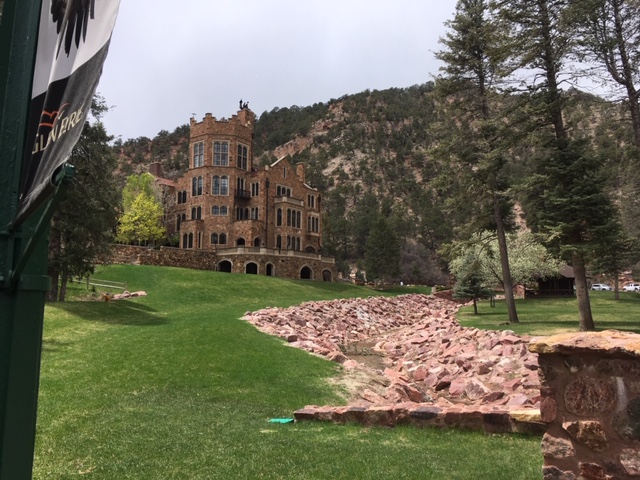
Glen Eyrie, a castle in the mountains.
Glen Eyrie

On Monday morning, I flew back to New England from the Imagination Redeemed conference in Colorado Springs – exhausted, full, and inspired. The conference was hosted by the Anselm Society, which hopes to spark a “renaissance of the Christian imagination” – a new understanding between the Church and the arts of how we can glorify God through visual art, music, literature, poetry, theater, and dance.

The conference was a feast of wisdom and fellowship. Scholars, artists, teachers, and writers discussed re-enchanting the church, medieval cosmology, sacred art, the moral imagination, writing as image-bearing, and more. I had wonderful talks with fellow attendees – writers, artists, ballet teachers, graduate students, opera singers, and others – about their work.

I’m tired. The richness of ideas and insights was overwhelming, and the red-eye return left me barely holding onto consciousness (my first all-nighter ever). But I’m also encouraged and inspired to meet so many people who are doing what I want to do, or share my ambitions: to glorify God through my art, to create and cultivate beauty, to share wisdom and joy through retelling God’s story.

I’ll probably reference the conference many times in future blog posts, but for now, I’ll share some of the goals the conference inspired:

Write – Heidi White’s talk about creating art inspired me to pour out essays, short stories, and books with greater courage, even if my words are only read by a few, because I’m not writing for my own fame or glory, but God’s. Lanier Ivester’s sonnet-writing workshop encouraged me to capture the inexpressible with imagery and challenge myself to greater creativity with meter and rhyme. Lancia Smith’s discussion of writing as image-bearing motivated me to bear or “bring forth” transcendent truths in stories.

Explore how my doctrinal beliefs shape me and my art – Though all the speakers were Christians, many came from an Anglican or Catholic background and discussed doctrines or practices that are outside of my faith tradition, including sacramental theology, a division between the clergy and the laity, and liturgy. Though Christians are all united by the blood of Christ and the Holy Spirit, doctrinal differences like these do shape our thinking and behavior. I want to explore my own theological framework to ensure that it is Biblically grounded and see how it affects my imagination, writing, and life choices.

Connect with other artists – I had so much fun meeting people who spoke my language, who know and love the same stories, who have similar dreams and challenges. Though I can travel to connect with other artists and writers, I would love to engage in that community here in New England, where geographical closeness makes it easier to build relationships.

Study – The speakers introduced me to so many fascinating ideas: musica mundana (medieval cosmology – “the music of the spheres”), kairos vs. chronos time, and more. I want to relearn Latin, study New Testament Greek, and read dozens of books and articles – a huge task, but all things I can accomplish eventually.

Engage with the Word – Junius Johnson, one of the speakers, encouraged artists and theologians to intentionally connect with each other. Theology is one of the best sources of inspiration, and art is a beautiful way to worship. I want to study the Bible deeply, reverently, and joyfully to better express God’s love and wisdom in my writing.

After learning so much and meeting so many wonderful people at the conference, I got to enjoy the beauty of Colorado Springs: Pike’s Peak shining with snow above the dark ridges of other mountains; Glen Eyrie castle tucked in a green valley; the Garden of the Gods, huge red rocks towering over the hills.

But it’s good to come home. In New England, soft pink buds are opening in the cherry trees, and new leaves are coming out in Scottish green. I’m tired, but full – eager to learn, to study, and to write stories of yearning.