

My second summer in Tennessee really has felt like paradise: golden hour tickling the dark green, feathery leaves of the honey locust trees; a writer’s retreat centered on the theme of music; dewdrops twinkling in the grass; triumphal teaching on the book of Acts; fireflies gleaming in the sweet, cool air after a thunderstorm; an online course on dragons that is filling my mind with insights and my heart with wonder.
It is also sweet to be fulfilling the dream of several years, starting a podcast. It is harder than I thought it would be to record my voice and send it out into the world. Hearing my own attempts to balance vocal projection, enthusiasm, calm, and proper enunciation feels like studying my face in a mirror for an uncomfortably long time. It is fun, though, to present my own writing in a new medium, a form that is more embodied and more vulnerable than text on a page.
The brand-new project is still flittering its frail wings and trying to comprehend gravity, but just launching it has taught me a few things: to not try to edit to perfection (it’s a good way to drive yourself mad); to do things the messy way at first, like Googling “how to put your podcast on Spotify” and cushioning my microphone with pillows; to enjoy the way that a podcast opens fascinating discussions with close family and friends.
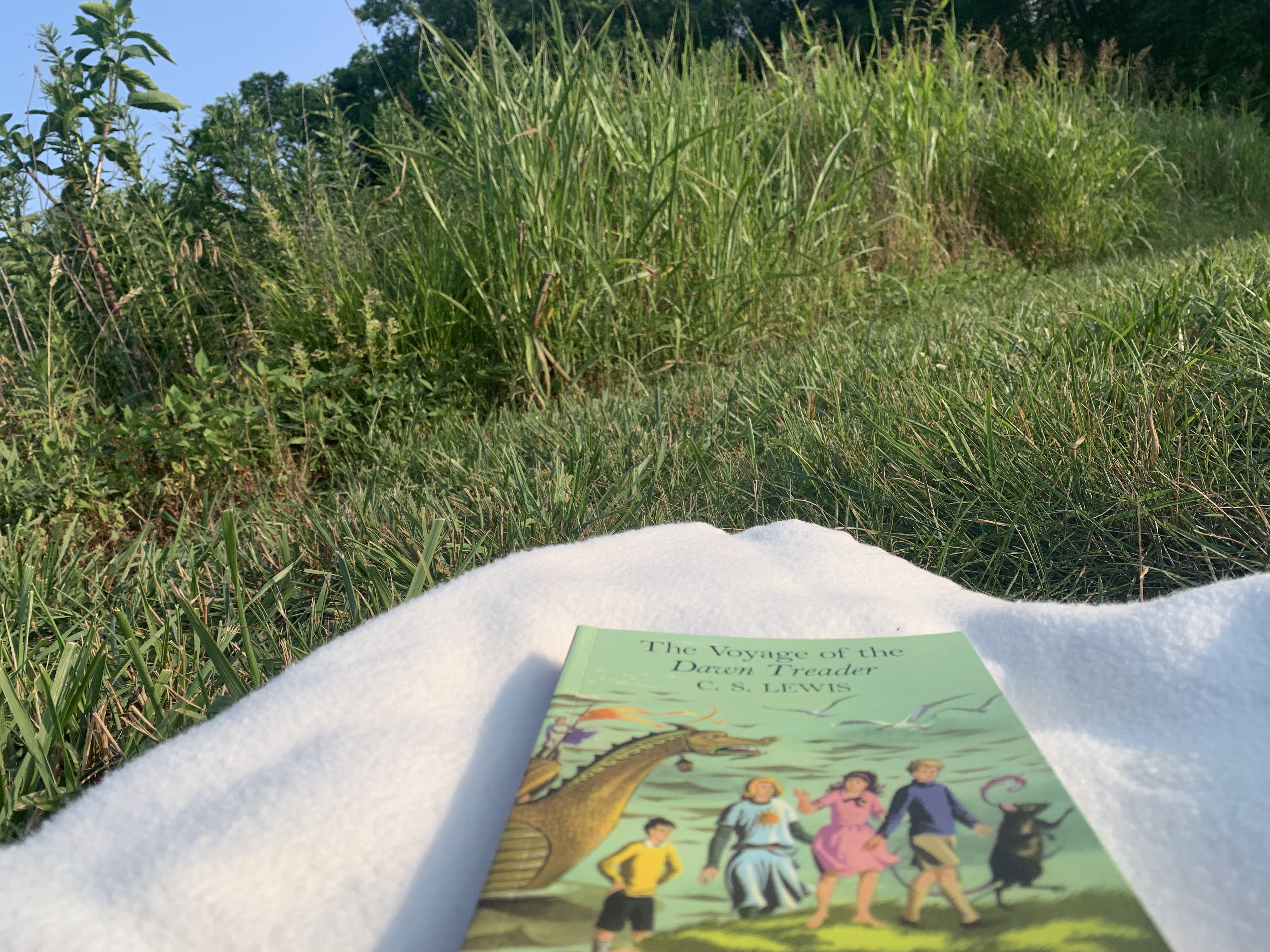
In between Scriptural word-studies on darkness and frost, puzzling over texts like Vladimir Propp’s venerable Morphology of the Folktale, rereading The Voyage of the Dawn Treader and The Hobbit, giggling over a P.G. Wodehouse audiobook as I water my plants, and basking in the sun to erase my flip-flop tan, I have been trying to write stories again. After a year of settling in a new place and trying to build a life, somehow, writing is harder rather than easier. It is a perilous, vulnerable, precious thing to try to call a world to life with words; shape believable, complex characters; set a rhythm of exposition, action, and dialogue that summons readers into the waking dream of narrative.
A sweet and wise writer at the recent writer’s retreat told me that she is trying to write primarily for herself, for joy, first, before worrying about pleasing an audience. I am trying to have the courage to imitate her in that – to refresh my spirit with good, profound, beautiful things, and then use them to sing a new song.
Leaf by Lantern – Latest Podcast Episodes
Episode 3: The Black Bull of Norroway
I had a lot of fun putting this episode together. The episode examines how a Christian artist could interpret or use the images of the unexpected call, the black bull, the wandering in the wilderness, and the glass hill from this fairy tale.
Things I forgot or didn’t have room to mention in the episode (these will make more sense if you’ve already listened to it):
- I think the image of the black bull, a figure who is mysterious and scary at first but turns out to be good and kind, has some symbolic links to the idea of “holy darkness” that C.S. Lewis explores in his own fairy tale retelling, Till We Have Faces. I may do a podcast episode on that book later.
- There are so many fascinating images in this tale I didn’t cover: the apple, pear, and plum given to the heroine that contain fabulous jewelry; the strange part of the tale when the sky turns red if the battle goes ill and blue if it goes well; the washing of the blood-stained shirt. I could have gone into themes of communion, provision, prophecy, sanctification, and recognition here – but to avoid making the episode too long or oversaturated with content, I had to focus on my favorite images.
- In my own version of the tale, the one I read aloud at the beginning, I chose to have the prince say “At last!” when he sees the main character, his true bride. This phrase is an echo of Adam’s exclamation when he first sees Eve.
Episode 4: Maid Maleen with Loren G. Warnemuende
My friend Loren and I talk about her retelling of “Maid Maleen” – a trilogy called “Daughter of Arden.” We talked about the first book, “Exile,” and how Loren chose to interpret the father figure, the princess, the tower, and the garden. I also threw in a question about fancy dresses, since I have come to believe those are a crucial aspect of fairy tale retellings.
 Stories of Yearning